Showing posts with label Economics-History. Show all posts

Sunday, July 14, 2024

Review of The Shock Doctrine: The Rise of Disaster Capitalism by Naomi Klein

This book review was written by Eugene Kernes   

Book can be found in: 
Book Club Event = Book List (01/25/2025)


Watch Short Review

Excerpts

“A more accurate term for a system that erases the boundaries between Big Government and Big Business is not liberal, conservative or capitalist but corporatist.  Its main characteristics are huge transfers of public wealth to private hands, often accompanied by exploding debt, an ever-widening chasm between the dazzling rich and the disposable poor and an aggressive nationalism that justifies bottomless spending on security.”– Naomi Klein, Chapter Introduction: Blank Is Beautiful, Page 18

“The principle was simple: countries in crisis desperately need emergency aid to stabilize their currencies.  When privatization and free-trade policies are packaged together with a financial bailout, countries have little choice but to accept the whole package.  The really clever part was that the economists themselves knew that free trade has nothing to do with ending a crisis, but that information was expertly “obfuscated.”” – Naomi Klein, Chapter 9: Crisis Works, Page 206

“That is pretty much the philosophy: stay in government just long enough to get an impressive title in a department handing out big contracts and to collect inside information on what will sell, then quit and sell access to your former colleagues.  Public service is reduced to little more than a reconnaissance mission for future work in the disaster capitalism complex.” – Naomi Klein, Chapter 15: A Corporatist State, Page 398


Review

Is This An Overview?

With disaster comes opportunity, a market opportunity.  Disasters are used to impose drastic changes on society, using shock therapy, rather than gradual changes.  Disasters are a shock to the system that enables policies to be accepted that would not have been acceptable otherwise.  To receive support or loans, sovereign states facing disaster are given conditions which generally include privatization, deregulation, and reduction in social spending. 


This has the effect of enacting policies that are favorable to markets, and gives access to foreign firms to buy resources and buyout domestic firms.  Resources and firms are sold relatively cheap, as the economy is facing disaster.  This is how disaster capitalism works.  Disaster makes sovereign states vulnerable to accept policies they would not otherwise accept, policies that are a form of colonialism.  The effect of shock therapy is to transfer public wealth to private individuals and groups, increase debt, and exacerbate inequality.  This situation is created by government and businesses working together.


The form of the disaster is not relevant.  Whether caused by nature or political conflict.  Although there had been many disasters available to which shock therapy was applied, there were disasters that were created.  When the democratic process chose means that were not favorable to those who were ready to take advantage of a disaster, methods were used to create a crisis such as the removal of democratically elected leaders and policies.  Replacing them with favorable leaders.  Undermining the democratic process, often with violent means.  Instituting and imposing authoritarian measures while claiming to that they are for liberty and the improvement of society.


Before disaster capitalism, societies wanted to avoid crises as that hurt the economy and the people.  Due to disaster capitalism, disaster has become profitable.  Rather than losing money due to a disaster, the economy benefits from a crisis.  Even when imposing a crisis on another economy.  Various firms profit from war activities, and then reconstruction efforts.  Firms are being rewarded with rebuilding what they enabled to destroy.  While war activity is compensated, the victims of disaster are not appropriately compensated.


Caveats?

The effects of shock therapy are considered from a variety of events from diverse sovereign states.  Many details are provided on the events, but there can be too many details or lack relevance which takes the focus away from a systematic account of the topic.  Even with the details provided, the reader would need to do more research to understand each event. 


This book challenges the myths of how effective economic policies have been.  The problem is that the author challenges the myths by providing myths.  This book is a form of destructive tribalism, in which the ideas and people who are the target of the book, are assumed to have an essence.  That anyone who engages with them shares all the same terrible ideas throughout time.  All the harm that is done, the author holds the target group responsible.  When a totalitarian sovereign state considers and changes their economy to be even a little more aligned with the target group, the target group is considered to be responsible for all the totalitarianism.  When the opponents of the target group have power and effect policies that are similar to what the target group wanted, the target group is considered responsible. 


Much like how the author criticizes the target group for wanting a pure market system without government, the author wants the targets to appear purely evil. The targets of the book are provided a one-sided narrative, and are given responsibility for every negative consequent.  The author references books written by the targets, but the content in those books that contradict the author’s claims are not referenced. 


The focus of the book is when the target group uses disasters for policy opportunities, even though there were a few references to non-target groups using disasters for policy opportunities.  By focusing only on a single target group and making them responsible for everything, has the effect of hiding and empowering other groups who use disasters for their benefit.  


Questions to Consider while Reading the Book

•What is the raison d’etre of the book?  For what purpose did the author write the book?  Why do people read this book?
•What are some limitations of the book?
•To whom would you suggest this book?
•What is disaster capitalism? 
•What is shock therapy? 
•What was the outcome of Hurricane Katrina? 
•What are demands of International Monetary Fund policies? 
•How is the democratic process treated for states undergoing shock therapy? 
•How does shock therapy effect inequality?
•What does it mean to be corporatists?
•How does torture (a.k.a. coercive interrogation) work?
•Can a person be repatterned? 
•How is a state tortured? 
•What happened to the U.S. domestic and foreign policy after 9/11?
•How is Friedman involved in shock therapy?
•What is the source for problems with the economy according to Friedman? 
•How are Keynesians involved in shock therapy? 
•What happened to the communist versus capitalist struggle after the collapse of the Soviet Union? 
•What does it mean to have a mixed economy? 
•What defines an enemy combatant?
•Why use an academic to create policy rather than a firm? 
•What kind of bailout package do states in a crisis receive? 
•Who benefits from shock therapy?
•Who loses from shock therapy?
•What kind of statistics did the International Monetary Fund provide? 
•What language is used to make shock therapy appear necessary? 
•How does shock therapy effect the culture of the state its applied to? 
•How do companies get their contracts? 
•How do government employees think of their government? 
•How did shock therapy effect Argentina?
•How did shock therapy effect Asian Tigers?
•How did shock therapy effect Bolivia?
•How did shock therapy effect Chile?
•How did shock therapy effect China?
•How did shock therapy effect Iraq?
•How did shock therapy effect Israel?
•How did shock therapy effect Poland?
•How did shock therapy effect Russia?
•How did shock therapy effect South Africa?
•How did shock therapy effect Sri Lanka?
•How did shock therapy effect United Kingdom?
•How did shock therapy effect United States of America?


Book Details
Publisher:               Picador [Henry Holt and Company]
Edition ISBN:         9780312427993
Pages to read:          587
Publication:             2007
1st Edition:              2007
Format:                    Paperback 

Ratings out of 5:
Readability    5
Content          4
Overall          3


Sunday, July 16, 2023

Review of Capitalism: A Short History by Jürgen Kocka

This book review was written by Eugene Kernes   

Book can be found in: 
Book Club Event = Book List (02/24/2024)


Watch Short Review

Excerpts

“With these findings in the history of concepts and theories as a foundation, and after having examined additional proposals for defining the term, I propose a working definition of capitalism that emphasizes decentralization, commodification, and accumulation as basic characteristics.  First, it is essential that individual and collective actors have rights, usually property rights, that enable them to make economic decisions in a relatively autonomous and decentralized way.  Second, markets serve as the main mechanisms of allocation and coordination; commodification permeates capitalism in many ways, including labor.  Third, capital is central, which means utilizing resources for present investment in expectation of future higher gains, accepting credit in addition to savings and earnings as sources of investment funds, dealing with uncertainty and risk, and maintaining profit and accumulation as goals.  Change, growth, and expansion are inscribed” – Jürgen Kocka, Chapter 1: What Does Capitalism Means?, Page 21

“These merchants traded on their own accounts, even if this was usually done in close coordination with the politically powerful, and often, moreover, in close cooperation with other merchants, typically in cross-border networks based on common ties of ethnicity, homeland, or religion.  There was no lack of profit seeking, daring, dynamism, or a willingness to cope with insecurity and competition.” – Jürgen Kocka, Chapter 2: Merchant Capitalism, Page 25

“In the controversies that have surrounded capitalism, state and market are usually regarded as antipodes, and for good reason.  Market action and governmental-political action are indeed beholden to different logics, especially in the democratic era.  Each one has different foundation on which its legitimacy rests: unequally distributed ownership rights on one side, equal citizenship rights on the other.  They follow different procedures: there one of exchange, here a process of debate with the aim of building consensus and deciding by majority.  There money is the most important medium; here, by contrast, it is power.” – Jürgen Kocka, Chapter 4: The Capitalist Era, Page 145


Review

Is This An Overview?

What defines capital and capitalism has changed.  Capital used to mean money in the process of making more money.  Then expanded into any asset that obtains a profit.  Capitalism came into being as a criticism of the class society.  Capitalism has become a set of aspects which are based on decentralized decision making, commodification, and accumulation.  Within capitalism, markets are the form in which people coordinate and distribute resources.  Capitalism uses various means to expand, to make investments that have an opportunity for greater future reward.   The more global a market is, the more sales opportunities there are. 

The philosophers during the Enlightenment era witnesses destructive wars undertaken by governments, which lead them to seek alternative decision making methods.  Enlightenment philosophers provided a defense for market capitalism, as it could be used as a civilizing force.  The state and market may often be seen in opposition to each other, for they rely on different methods and procedures.  But markets and political power cannot be readily separated.  Capitalists have used government influence to shape production.  To protect their assets, even against competition.  The state and market have different functions, but each relies on the other’s function, to function.  Capitalism also has inherent problems, such as business cycles.  Capitalism values individualism, but too much individualism breaks social ties.  Firms under capitalism can behave in inappropriate ways to earn a profit, such as exploit labor.  Firm behavior that gave rise to labor movements. 


Caveats?

This book contains a diverse global history on the methods of capitalism.  Although there is a vast range of history, there is very little content on each historic example and explanation.  Most examples serve as proofs of concept rather than build comprehension of the topic.  Readers who already know more details about the examples are in a better position to understand the context of the ideas.

Social values change.  There are various historical state and market features that have become derided because of the change in values.  Although the author sometimes acknowledges that states have used what has become inappropriate methods of production, the author generally highlights capitalisms involvement in the inappropriate methods of production.  The negative consequences of capitalism are provided, but not the same aspects and consequences within state operations.


Questions to Consider while Reading the Book

•What is the raison d’etre of the book?  For what purpose did the author write the book?  Why do people read this book?
•What are some limitations of the book?
•To whom would you suggest this book?
•What is capitalism?  How has the word changed meaning?
•What is capital?  How has the word changed meaning?
•What is merchant capitalism? 
•How did the Enlightenment shape capitalism? 
•What is utopian capitalism? 
•How did industrialization change capitalism? 
•How do markets operate? 
•Is there a need for a state? 
•What are the problems with capitalism?
•What inspired the labor movement? 
•What are business cycles? 
•How did Karl Marks influence capitalism?
•How did Joseph Schumpeter influence capitalism? 

Book Details
Translator:            Jürgen Kocka
Publisher:             Princeton University Press
Edition ISBN:      9780691178226
Pages to read:       171
Publication:          2018
1st Edition:           2013
Format:                 Paperback 

Ratings out of 5:
Readability    5
Content          3
Overall          3


Monday, November 29, 2021

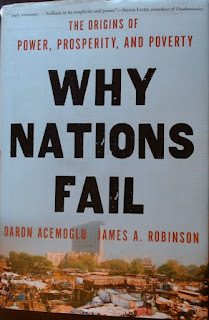
Review of Why Nations Fail: The Origins of Power, Prosperity, and Poverty by Daron Acemoğlu, James A. Robinson

This book review was written by Eugene Kernes

Book can be found in:
Genre = Economics, History
Intriguing Connections = 1) Get To Know The Peoples Of The World (World History

Short Description

Elaborate Description

Overview:

Political and economic institutions shape incentives for everyone in the society.  Political and economic rules are created and enforced by citizens and state.  While the economic system shapes how people earn an income, trade, and innovate, it is the political process that determines under what economic system people live under.  Inclusive economic institution encourage participation of everyone in economic activity by unbiased laws, property rights, public services, level playing field for exchange and contract, entry of new business, and individual’s ability to choose their careers.  Extractive economic institutions have the inverse properties of inclusive economic institutions, and extract wealth from society to the benefit of a few.  Societies choose their economic system through the political process in which they decide what rules to enforce.  There is synergy between inclusive political and economic institutions, as there is synergy between extractive political and economic institutions, because those in power will try to retain their status.  

Inclusive economic institutions facilitate a willingness of individuals to partake in economic activity knowing that their output will not be arbitrarily taken.  As individuals will get rewarded for their output, they are more willing to invest and increase productivity.  Inclusive economic institutions create inclusive markets that provide individuals with the same opportunities to utilize their talents.  Facilitate obtaining skills and work suited for the individual.  Inclusive political institutions have power broadly distributed, and constrain arbitrary power.  They have elected representatives which are replaced when they misbehave.  

Extractive political institutions do not have many constraints on exercise of power.  Leading to extractive economic institutions which are structured to extract resources from the rest of society.  To extract wealth, extractive institutions do need some way to stimulate economic activity.  Limited prosperity directed to benefit the few.  They exclude their citizens from participating in political decisions.  

Creative destruction can create different losers and winners.  Those who might lose from creative destruction fear inclusive economic and political institutions.  Those controlling political power can limit competition to prevent degradation of their privileges.  

Critical junctures are events which can disrupt societies political mix.  They can break the vicious cycle of extractive institutions, or can endanger inclusive institutions.   Inclusive economic and political institutions tend to emerge after a conflict, as there are powers wanting to maintain the status quo.  In many cases, conquerors could not coerce labor.  The tools they used were instead to incentive labor.  To get people to want to work.  

Many public services can be provided by the market, but the state has a unique ability to coordinate on a large scale.  Markets are not free from becoming extractive when few firms control most of the market.  Needing a kind of political centralization to provide law and order.  To enable coordination without obtaining monopoly powers that lead to extractive institutions. 


Caveats?

This book provides an easy read and a very good understanding of how political and economic institutions shape inequality.  Using historical analysis to bring about that understanding.  The problem is that there are many issues and inconsistencies in the book.  

The focus of the book is only on political and economic institutions, while eager to dismiss the alterative views of geography, culture, and knowledge as factors in inequality.  Those factors might not explain everything, but they have shaped what the political and economic institutions people live under.  Therein also lies an inconsistency, as during certain parts of the book, the authors used geography, culture, and knowledge as reasons for obtaining certain types of political and economic institutions. 

The historical examples quality is mixed.  Sometimes there is an in-depth background into the problems of a nation.  Other times, incidents are given and described in terms of only inclusive or extractive economic and political institutions, but there were a lot more to the events which can provide a different understanding.  There is a lot of history in this book, mainly with the start of the Industrial Revolution, but even during the low historical quality events, it enables the reader to search for more information on the nations.  

There is an inconsistency in which inclusive and extractive institutions are described.  It appears that inclusive political institutions only produce inclusive economic systems, while extractive political systems only produce extractive economic systems.  As in, there appears to be a separation between inclusive and extractive institution.  The problem is that economies have a mixture of both inclusive and extractive institutions.  In the histories presented, there were turns to and from inclusive or extractive institutions.  Which means, and the author do make the claim, that there was conflict between those within the nations on the opposing sides.  Not realistic for a society to be completely inclusive, while it may appear that complete extraction is possible. 

The issue of the mixture of inclusive and extractive institutions brings up an associated idea of dependency on the past.  It appears that there is no way to change the inclusive or extractive institutions without critical junctures.  Critical junctures appear random, but this might be because their outcomes during their time were uncertain.  The problem is that the conflicts and events of the critical junctures, had social backing and their own precedence.  Not very predictable ones, but did require some impetus before the critical juncture.  

Questions to Consider while Reading the Book

•What is the raison d’etre of the book?  For what purpose did the author write the book?
•What are political institutions?
•What are economic institutions?
•What makes political and economic institutions inclusive?  What makes them extractive?
•Why do inclusive institutions create more inclusion while extractive institutions keep extracting?
•Who creates the rules?  Who enforces the rules? 
•What is creative destruction? 
•Why are critical junctures important? 
•Why is government needed? 
•What is the dual economy?

Book Details
Edition ISBN:  9780307719218
Pages to read:   462
Publication:     2012
1st Edition:      2012
Format:            Hardcover

Ratings out of 5:
Readability    5
Content          4
Overall           4


Monday, November 1, 2021

Review of The Economic Consequences of the Peace by John Maynard Keynes

This book review was written by Eugene Kernes

Book can be found in:
Genre = Economics, History

Short Description

Excerpts
“The power to become habituated to his surroundings is a marked characteristic of mankind.  Very few of us realize with conviction the intensely unusual, unstable, temporary nature of the economic organization by which Western Europe has lived for the last half century.” – John Maynard Keynes, Introductory, Page 5

“The immense accumulation of fixed capital which, to the great benefit of mankind, were built up during the half century before the war.” – John Maynard Keynes, Europe before the war, Page 14

“To limit the population of Germany and weaken her economic system, is clothed, for the President’s sake, in the august language of freedom and international equality.” – John Maynard Keynes, The Conference, Page 35

Elaborate Description

Overview:

After the end of the First World War, the question was what to do with the defeated.  The Paris Peace Conference was meant to determine the solution.  John Maynard Keynes was an official representative, but had to resign from the position due to disapproval of the solutions, which were not going to be modified.  The treaty was set to impair the fragile organization and economic system already disrupted by the war.  Those who won the war, were abusing their power which would inevitably invite their destruction.  The actions of the winners were made to serve noble purposes and have moral support while making a caricature of the defeated who would have their population limited and economy weakened.  Reparation debt was to be so high as to make the numbers useless.  Resources extracted from would have prevented the defeated from using any, while limiting production in the winners’ nations.

Economic systems are very complicated and temporary, but people have a tendency to become habituated to their lifestyles.  The lifestyle of the Europe before the war was fairly pleasant, in which people could purchase what they needed to be delivered to their home, and travel to foreign places with ease.  Income inequality facilitated those who did not consume all their income, to invest it.  Creating massive improvement that helped everyone.  The instabilities before the war included excess population, inequality, and limited agriculture.   

Keynes uses psychology, history, and economics to make the case that the treaty had many flaws.  There is account of the proceeding and descriptions of the representatives.  


Problems?

Generally poorly written, but there are some sections from which insight could be gained.  Prescient for its time, and not that technical.  Containing a diverse set of insights about the treaty background and internal affairs, but needs to be edited.  


Questions to Consider while Reading the Book

•What is the raison d’etre of the book?  For what purpose did the author write the book?
•Why did John Maynard Keynes resign the post for the peace conference? 
•How was Europe before the war? 
•Describe the conferences representatives. 
•How did the winners treat the defeated?
•What was to be the punishment imposed on the defeated?
•What were the social problems with the treaty?
•What were the economic problems with the treaty? 
•Why did Keynes believe that the treaty was terrible?

Book Details
Edition ISBN:  9788826017136
Pages to read:   166
Publication:     2017
1st Edition:      1919
Format:            eBook

Ratings out of 5:
Readability    1
Content          2
Overall           2

Monday, May 31, 2021

Review of Wealth, Poverty and Politics by Thomas Sowell

This book review was written by Eugene Kernes

Book can be found in:
Genre = Economics, History
Intriguing Connections = 1) Get To Know The Peoples Of The World (World History


Watch Short Review

Quotes
“It is especially painful when policies to help the poor misfire and leave the poor worse off, since they have less margin with which to absorb the consequences of other people’s errors.” – Thomas Sowell, Preface, Page 6

“Facts do not speak for themselves.  They speak for or against competing beliefs or competing theories.  If the study of facts cannot always be definitive, it can at least be clarifying.  And there are few issues more in need of clarification than issues involving wealth, poverty and politics.” – Thomas Sowell, Preface, Page 10

“There is nothing automatic about prosperity.” – Thomas Sowell, Issues, Page 11
Quotes with permission from publisher
Elaborate Description

Economic inequalities are common in the history of people.  What changed are the patterns of the inequalities.  Prosperity requires time and work.  Wealth needs to be produced rather than just come into existence.  Economic incentives change production capacities.  Rather than make counterproductive social policies to escape responsibility, people have to learn to shape their society with habits and values that enable them to become productive and produce wealth.  Success requires many prerequisites factors, while not having just a single factor can lead to failure.  Interactions between the various factors influences the outcomes, each is not deterministic.  Learning from different peoples allows access to skills and knowledge which leads to overcoming many limitations.  Isolated peoples are deprived of alternative ways to handle limitations.   

Output creates the standard of living rather than the money, for it was money then government would print money to create the standard of living.  Economic disparities are caused by either how a people produce wealth, or by transfers.  Confusing production and transfer carries consequences for the future of nations.  When policy makers design policies that impact the poor, it is tragic when they do not help because the poor bear the cost of the policies, and it is the poor who have less ability to overcome the consequences created by other people’s error.  Understanding what influences on prosperity and poverty can help identity what is needed to create prosperity, and what leads to poverty.  Peoples who rose from impoverished backgrounds to prosperity are not privileged, they have made an achievement. 

Geography does not determine what people can do, but it certainly influences the options available by either limiting them, or expanding them.  Location can allow people to develop their own mental capacities, and specialties.  Resources, geography, and climate are different in various regions.  Each has its own advantages and disadvantages to humans.  Each creates different opportunities for human development.  What matters is how geography interacts with non-geography factors such as culture, politics, and various other influences.  Due to the variety of different interactions, they can produce vastly different economic outcomes.  There are regions with little natural resources that are wealthy, and regions with lots of natural resources but are poor.  Geographic use changes over time as human knowledge and technologies advance.  Transportation, and other technological advances, can mitigate or remove various geographic impediments.  Even altering geographic features.

Isolation, whether physical or socially imposed, limits growth and usually regress a society.  Knowledge and technology are not isolated to a particular people.  Including diverse groups brings with it their knowledge and skills, while isolating a people reduces their ability to come up with alternative solutions to their limitations.  Discoveries and inventions can come from every society, with no society being the sole source of all discoveries and inventions.  By having contact with peoples of different societies, discoveries and inventions transfer via people.  Knowing how other people handle limitations informs others how to change, rather than be depended on the same actions.  An isolated culture contains a disadvantage in which it cannot access those different knowledge and technology to impact their limitations.  

Culture influences how a peoples create wealth.  Cultures that develop human capital are able to generate wealth where ever they go, but cultures that rely on others to generate wealth become poor when they cannot access the others.  Conquers plundering wealth are wealthy as long as there is military glory to be held, but the military culture is an impediment when military glory is not possible.  There were people who were forced to exile while leaving their wealth behind, but rose to prosperity.  Genetic determinism cannot explain the extreme reversals of wealth and poverty of nations.  Cultural values that prioritize acquisition of skills have generally become prosperous.  People needed to develop human capital to deal with circumstances.  In other circumstances, people did not need to develop human capital.  

Cultural aspects have been borrowed from other cultures for their own benefit.  While some cultures are receptive to foreign ideas and products, other cultures are antagonistic to alternatives.  Exiling certain groups from a nation tended to impoverish the nation while increasing the wealth of the nations that welcomed the exiles.   Those who did not compete before did not develop human skills needed when different cultures became prominent.  Rather than developing the skills needed to generate wealth, many groups have claimed that they were being exploited because they could not compete with harder working peoples.   

Coordination among people who trust in each other reduces the risk of engagement which facilitates faster economic decision making.  An economy that has a lot of corruption reduces the ability to form bonds between people which make it hard peruse ventures such as business and investment.  Coordination requires communication, and communication depends on language, whose value increases as more people speak it.

Government is like any institution that has limitation and its own interests.  In a democracy, to get into positions of power requires them to compete using visions for what to do with that power.  The cost of this competition is that reality gets punished if it deviates from popular beliefs, as such, politicians tend to tell voters what the voters want to hear.  It is through manipulating reality that politicians get hired.  Politicians try to protect the egos of the majority than utilize the skills and knowledge available in the economy.  

The writing is eloquent and provides a lot of depth to the range of topics.  The problem is that Sowell sometimes dismisses certain views too quickly.  Although providing an understanding of alternatives views, by dismissing some popular ones, it becomes difficult to understand the reasons.  Although Sowell makes the point that each factor influences rather than determines outcomes, there are examples used to describe different groups as if the particular aspect determines the differences, or at least are more prominent than others.  


Questions to Consider while Reading the Book

•What is the raison d’etre of the book?  For what purpose did the author write the book?
•What is wealth?  How is wealth obtained? 
•Can a particular factor determine the fate of human development? 
•Why have there been inequalities between peoples?
•What factors influence economic outcomes?  Does each factor matter?  What happens when they interact? 
•What influence does geography have on the people?
•What does isolation do to a people?
•What influence does culture have on the people? 
•How do different culture interact within a nation? 
•Why are exile a people?  What happens to the nation that exiled them and to the nations that welcomed them? 
•What are social factors? 
•How does politics impact people? 
•What are the roles of government? 
•Who do people vote for? 

Book Details
Edition ISBN:  9780465096770
Pages to read:   389
Publication:     2016
1st Edition:      2015
Format:            eBook

Ratings out of 5:
Readability    5
Content          5
Overall           5

Saturday, November 7, 2020

Review of The Invisible Hook: The Hidden Economics of Pirates by Peter T. Leeson

This book review was written by Eugene Kernes

Book can be found in:
Genre = Economics, History
Intriguing Connections = 1) Get To Know The Peoples Of The World (Pirates), 

Elaborate Description

It becomes more and more apparent that pirates had better democratic institutions than that the current developed democratic nations. The democratic system pirates created punished those that broke the laws of the ship and rewarded those that followed them. The way externalities were fixed on board pirate ships with no government is something developed countries should be jealous of. Captain's, whether they where merchant or pirate, that did not take care of their crew got justice served upon them by the pirate crew. The extra brutality that pirates are known for, actually was used to save both pirate and innocent sailor life alike. The gargantuan amount of economics used to explain pirate behavior is marvel. Economics can be described so eloquently only by a few economists. The transition from understanding economics, to the implications of it on pirate behavior is extremely smooth.


Book Details

Edition ISBN:  9780691150093
Pages to read:   215
Publication:     2009
1st Edition:      2009
Format:            Paperback

Ratings out of 5:
Readability    5
Content          5
Overall           5

Review of The Great Transformation: The Political and Economic Origins of Our Time by Karl Polanyi

Book can be found in:
Genre = Economics, History

Elaborate Description

A book that tries to point out that capitalism has costs and that certain institutions prevent the cost from exacerbating. It is true that progress has some creative destruction and those that are harmed by it could be helped until they are better, but it does not mean that progress should be slowed or halted just because a few become harmed. The book does a good job at discussing both the advantages and disadvantages of the system and policies which creates credibility that the author is trying not to hide any aspect. This book is like the antithesis to Hayek's Road To Serfdom, for in this book regulating production creates a free society. A problem with the book is that capitalism is explained in the extreme where human emotion is taken out while social interaction while socialism is taken in a moderate sense rather than extreme; creating a disadvantage for any free market policy in the book. For example, the author explains that in socialism many people can trade via reciprocity rather than just money exchange as in a capitalistic system, but reciprocity exist in society in any system a nation is under because it is a human emotion rather than inherent in a socialist system. The author at times gives a good explanation of a certain policy outcome but declares a huge extrapolation that is far from what has been explained. Sometimes an explanation is not even given by a remark of apparent obviousness of the meaning, the problem is that what might be obvious to the author is not so obvious to the reader who might appreciate a little more explanation.


Book Details

Edition ISBN:  9780807056431
Pages to read:   303
Publication:     2001
1st Edition:      1957
Format:            Paperback

Ratings out of 5:
Readability    2
Content          4
Overall           3

Friday, November 6, 2020

Review of The World That Trade Created: Society, Culture and the World Economy, 1400 to the Present by Kenneth Pomeranz, Steven C. Topik

This book review was written by Eugene Kernes

Book can be found in:
Genre = Economics, History
Intriguing Connections = 1) Get To Know The Peoples Of The World (World History), 

Elaborate Description

This book presents various topics on how trade created the world as we know it. Many regions and peoples of the world are represented, their interconnections and interdependencies, provide different cultures of trade are exquisite. Commodities change their local identity when they begin to be traded by various peoples. Trade created new opportunities and demands, but also changed the fates. New and old sources of ingenuity become used differently in other cultures.

The book is organized not by the timeline of history, but by sections such as transportation, violence, and commodities. Each section has various short examples on different aspects that represent that topic. The authors wrote the pages with eloquence. Rather then just explain what happened, the success of the book is in targeting the lessons to be learned from the particular trade aspect.

One of the problems of the book is that it is written in a more deterministic style. The conclusion to the book represented the volatility of events that shape the various potential futures, but the historic examples provided are more linear.


Book Details

Edition ISBN:  9780765623553
Pages to read:   307
Publication:     2012
1st Edition:      1999
Format:            Paperback

Ratings out of 5:
Readability    5
Content          5
Overall           5