Monday, November 29, 2021

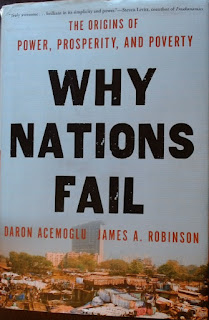
Review of Why Nations Fail: The Origins of Power, Prosperity, and Poverty by Daron Acemoğlu, James A. Robinson

This book review was written by Eugene Kernes

Book can be found in:
Genre = Economics, History
Intriguing Connections = 1) Get To Know The Peoples Of The World (World History) 

Short Description

Elaborate Description

Overview:

Political and economic institutions shape incentives for everyone in the society.  Political and economic rules are created and enforced by citizens and state.  While the economic system shapes how people earn an income, trade, and innovate, it is the political process that determines under what economic system people live under.  Inclusive economic institution encourage participation of everyone in economic activity by unbiased laws, property rights, public services, level playing field for exchange and contract, entry of new business, and individual’s ability to choose their careers.  Extractive economic institutions have the inverse properties of inclusive economic institutions, and extract wealth from society to the benefit of a few.  Societies choose their economic system through the political process in which they decide what rules to enforce.  There is synergy between inclusive political and economic institutions, as there is synergy between extractive political and economic institutions, because those in power will try to retain their status.  

Inclusive economic institutions facilitate a willingness of individuals to partake in economic activity knowing that their output will not be arbitrarily taken.  As individuals will get rewarded for their output, they are more willing to invest and increase productivity.  Inclusive economic institutions create inclusive markets that provide individuals with the same opportunities to utilize their talents.  Facilitate obtaining skills and work suited for the individual.  Inclusive political institutions have power broadly distributed, and constrain arbitrary power.  They have elected representatives which are replaced when they misbehave.  

Extractive political institutions do not have many constraints on exercise of power.  Leading to extractive economic institutions which are structured to extract resources from the rest of society.  To extract wealth, extractive institutions do need some way to stimulate economic activity.  Limited prosperity directed to benefit the few.  They exclude their citizens from participating in political decisions.  

Creative destruction can create different losers and winners.  Those who might lose from creative destruction fear inclusive economic and political institutions.  Those controlling political power can limit competition to prevent degradation of their privileges.  

Critical junctures are events which can disrupt societies political mix.  They can break the vicious cycle of extractive institutions, or can endanger inclusive institutions.   Inclusive economic and political institutions tend to emerge after a conflict, as there are powers wanting to maintain the status quo.  In many cases, conquerors could not coerce labor.  The tools they used were instead to incentive labor.  To get people to want to work.  

Many public services can be provided by the market, but the state has a unique ability to coordinate on a large scale.  Markets are not free from becoming extractive when few firms control most of the market.  Needing a kind of political centralization to provide law and order.  To enable coordination without obtaining monopoly powers that lead to extractive institutions. 


Caveats?

This book provides an easy read and a very good understanding of how political and economic institutions shape inequality.  Using historical analysis to bring about that understanding.  The problem is that there are many issues and inconsistencies in the book.  

The focus of the book is only on political and economic institutions, while eager to dismiss the alterative views of geography, culture, and knowledge as factors in inequality.  Those factors might not explain everything, but they have shaped what the political and economic institutions people live under.  Therein also lies an inconsistency, as during certain parts of the book, the authors used geography, culture, and knowledge as reasons for obtaining certain types of political and economic institutions. 

The historical examples quality is mixed.  Sometimes there is an in-depth background into the problems of a nation.  Other times, incidents are given and described in terms of only inclusive or extractive economic and political institutions, but there were a lot more to the events which can provide a different understanding.  There is a lot of history in this book, mainly with the start of the Industrial Revolution, but even during the low historical quality events, it enables the reader to search for more information on the nations.  

There is an inconsistency in which inclusive and extractive institutions are described.  It appears that inclusive political institutions only produce inclusive economic systems, while extractive political systems only produce extractive economic systems.  As in, there appears to be a separation between inclusive and extractive institution.  The problem is that economies have a mixture of both inclusive and extractive institutions.  In the histories presented, there were turns to and from inclusive or extractive institutions.  Which means, and the author do make the claim, that there was conflict between those within the nations on the opposing sides.  Not realistic for a society to be completely inclusive, while it may appear that complete extraction is possible. 

The issue of the mixture of inclusive and extractive institutions brings up an associated idea of dependency on the past.  It appears that there is no way to change the inclusive or extractive institutions without critical junctures.  Critical junctures appear random, but this might be because their outcomes during their time were uncertain.  The problem is that the conflicts and events of the critical junctures, had social backing and their own precedence.  Not very predictable ones, but did require some impetus before the critical juncture.  

Questions to Consider while Reading the Book

•What is the raison d’etre of the book?  For what purpose did the author write the book?
•What are political institutions?
•What are economic institutions?
•What makes political and economic institutions inclusive?  What makes them extractive?
•Why do inclusive institutions create more inclusion while extractive institutions keep extracting?
•Who creates the rules?  Who enforces the rules? 
•What is creative destruction? 
•Why are critical junctures important? 
•Why is government needed? 
•What is the dual economy?

Book Details
Edition ISBN:  9780307719218
Pages to read:   462
Publication:     2012
1st Edition:      2012
Format:            Hardcover

Ratings out of 5:
Readability    5
Content          4
Overall           4


Friday, November 26, 2021

Review of The Secret Formula of Strategic Thinkers: Winning Steps for Sustained Success by Cory Smith

This review was written by Eugene Kernes

Book can be found in:

Short Description

Elaborate Description

Overview:

Chess is more than just a game, it is a mindset.  Chess provides a way of thinking that can be beneficial to everyday life.  Such as influencing the outcome of a situation by applying strategies.  Planning ahead orients decisions to conform with set goals.  Which facilitates control of what happens, rather than life just happening.  Strategy involves utilizing available resources towards an objective.  Adjusting the objective to become realistic and achievable.  Strategy involves a conflict between interest and resolution.  Strategy allows the individual to overcome obstacles.  Much like in chess, the more information is known, the more informed strategies become.  A way to obtain more information is by looking at situations from different perspectives.  Becoming a strategic thinker requires the individual to know one’s self.  This book being a general guide to getting to know one’s self, to obtain self-knowledge.  


Caveats?

This book is easy to read, but has many inconsistencies.  The basic premise is to use chess skills in real life.  The problem is that chess and life have different complexities.  In chess, rules rarely change.  Learned rules can easily apply to future scenarios.  While in life, rules change quickly.  What was successful recently, cannot easily become applicable moving forward.  Life cannot be manipulated as pieces in chess. 

Part of the book requires a bit of cognitive dissonance, or maybe the language needs to be made more consistent.  The cognitive dissonance comes how much control an individual has over their lives.  From seeing the outcome of a plan static and trying to fulfill it, but also being fluid.  As in that the individual can control the outcome, but also not really.  There is an acknowledgement that the future is uncertain, but most claims are for controlling an outcome.  Individual’s may have some control over their lives, but the book reads as if individual’s control everything about their lives.  

This book sets up many self-help guidelines.  The problem is that they can help or can hurt.  There are many different ways of achieving some of the general claims of self-help virtues, but different people will need to find their own way of achieving them.  The tasks need to be put in context with individual values.  

Questions to Consider while Reading the Book
•What is the raison d’etre of the book?  For what purpose did the author write the book?
•How can chess be applied to everyday thinking?
•What is a strategy?
•Why should plans be made?
•How to get more informed strategies?
•How does an individual learn about one’s self?
•How much control over the outcome does an individual have?

Book Details
My version was provided by NetGalley
Edition ISBN:  9798498933863
Pages to read:   76
Publication:     2021
1st Edition:      2021
Format:           eBook

Ratings out of 5:
Readability    5
Content          3
Overall           3

Monday, November 22, 2021

Review of The Clash of Economic Ideas by Lawrence H. White

This review was written by Eugene Kernes

Book can be found in:
Genre = Economics
Intriguing Connections = 1) Learning Economics: Basic to Advanced,


Short Description

Elaborate Description

Overview:

Economic ideas clashed on the role of government and the process of competition.  Discussing the different roles of monetary policy to economic crisis management.  Many of the ideas were taken up by governments, creating experiments which determined which ideas had merit and problems.  All ideas presented had problems with application.  What matters is how to ameliorate the ideas.  Not only are economic ideas disputed, but whether economic ideas themselves hold value.  From those that consider them useless given that those in power will utilize policies which are then adopted by academics who maintain the views.  To application of even derelict ideas to the detriment of policy.  No matter the claims of economists, many ideas and policies persist, even those that contradict their claims.  While academics discuss the economy as is, policy advice is laden with what the economy should be.  

Socialism is normally described as government control over various aspects of the economy.  But there are different techniques involved in commanding the economy.  Capitalism is normally described leaving the economy in the guidance of private control directed by profit and loss.  But there is a need to delineate capitalism guided by the government known as state and crony capitalism from the guide of free market as free-market capitalism.  Those promoting decentralized ownership with competitive markets wanted them for the benefit of workers and consumers, not businessmen.  

Some of the leading figures in the clash of economic ideas were John Maynard Keynes, and F.A. Hayek.  While Keynes wanted government to take more control over the economy, but did not want to abolish the market.  Hayek wanted to reduce government’s interference with market forces, but did not want to abolish the government.   

The price system enables coordination between individuals.  When the Bolsheviks outlawed private property, they removed the price system which led to economic disaster.  As the alternative was starvation, many sectors of the economy readmitted market exchange, which improved economic conditions.  The profit system decentralizes production decision makers, while discouraging wasteful decisions.  The market economy acts as a discovery mechanism of alternative options.  


Caveats?

The book is sometimes well written, other times more difficult.  The problem is that for some chapters and ideas, it is less a clash and more a bash of ideas.  In which the perceived wrong idea is not necessarily given an appropriate understanding to what the idea entails, and as to why there were individuals who believe them. 


Questions to Consider while Reading the Book
•What is the raison d’etre of the book?  For what purpose did the author write the book?
•Do economic ideas have value?
•What is the appropriate role for the government?
•What is socialism?
•What is capitalism?
•What happens when government take too much control of the economy?
•What happens when markets take too much control of the economy?
•What influence did economic ideas have on policies?
•Were the policies that used the economic ideas, use them appropriately?
•Why is there disagreement between economic ideas?
•What were some monetary policy disagreements?
•What were the different views on the making of an economic crisis?  How did economists want to resolve economic crisis? 

Book Details
Edition ISBN:  9781139366038
Pages to read:   494
Publication:     2012
1st Edition:      2012
Format:            eBook

Ratings out of 5:
Readability    4
Content          3
Overall           3

Saturday, November 20, 2021

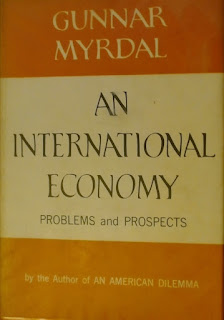
Review of An International Economy: Problems and Prospects by Gunnar Myrdal

This review was written by Eugene Kernes

Book can be found in:
Genre = Economics

Short Description

Elaborate Description

Overview:

Integration refers to national communities being brought closer to interdependence by internal and mutual adjustments.  Economic integration is an ideal in which everyone gets access to the same opportunities no matter the background of the individual.  Requiring changing social norms.  The problem is that policy cannot easily change the reality of the vast differences in people’s beliefs, interests, cultures, and other differences.  Liberalization of international trade on its own cannot affect integration.  Trade can widen the gap between living standards, and can perpetuate stagnation in underdeveloped regions.  While richer countries advance, poorer countries either stagnate or progress slower.  National integration and regional cooperation are needed to gain bargaining power, which is needed for political balance.

This book showcases the problems with integration such as with industrialization, certain regions has led to the exploitation of natural resources.  When populations urbanized, it broke down social ties and enforced mobility.  Those in power want economic development, but to get it without changing the social structure in which they have been the beneficiaries.


Caveats?

This book is very difficult to read.  Makes it hard to understand the important issues presented.  The book was written for contemporaries of the 1950s, and as such, contains many events that are no longer very applicable to current situations.   General insights can be gained, but to understand the specifics would require background knowledge into the issues of the time.   As the book focuses on problems of development, it can appear that the author is against the development of economies.


Questions to Consider while Reading the Book
•What is the raison d’etre of the book?  For what purpose did the author write the book?
•What is economic integration?  
•What is the difference between national and international integration?
•Why does integration challenge regional differences?
•What is the impact of trade?
•How can economies develop?
•Who does not want to develop their economies?
•Should trade be regulated?

Book Details
Edition Library of Congress:  5412156
Pages to read:   343
Publication:     1956
1st Edition:      1956
Format:            Hardcover

Ratings out of 5:
Readability    1
Content          2
Overall           1


Monday, November 15, 2021

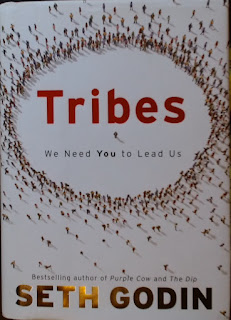
Review of Tribes: We Need You to Lead Us by Seth Godin

This review was written by Eugene Kernes

Book can be found in:
Genre = Economics, Business

Watch Short Review

Elaborate Description

Overview:

Humans are social beings and want to belong.  Tribes make life better.  Tribes are people connected to a leader and an idea.  Requiring a shared interest, and a method of communication.  Tribes need leadership, and vice versa.  Leaders are meant to be agents of change.  To overcome potential social consequences.  Although many fear failure which paralyzes decisions making, doing nothing accomplishes nothing.  Being wrong is not fatal.  What it takes is a willingness to be wrong.  Anyone can become a leader, and there are many opportunities to be one given the abundance and diversity of tribes.  Even a single individual can change society.  Change challenges the status quo, and leaders are those who rise up to take on that challenge.  

Management is about utilizing resources for a known job.  Leadership is about creating change.  Leadership is uncompromising and does not settle.  Leaders are partisan as partisans want to make a difference.  Leaders become influential because of their tribe.  Leaders build connections that empower the tribe to communicate, rather than dictating commands.  Less about what the tribe promotes, and more about the connections that are made.  Leader’s focus is on the tribe, and only the tribe. Willing to make personal sacrifices for the tribe.  Leaders go beyond the discomfort, which makes them so rare.  Leaders are not like other people.  

There is a lot of leverage to make change happen, embroiled in a marketplace that pleads for the remarkable.  Heretics have become prized for leadership.  Those who challenge the status quo.  Growth requires customers who believe in the leader and support the idea and product.  Customers are looking for products that are different, that are exciting.  For customers, patrons, or tribe members, numbers are less effective than fans.  Fans provide the commitment.  Tribe members who just follow instruction are not going to actively engage, nor will recruit others.

There are tribes which do their best to maintain the status quo and prevent dissent.  Change means that their ways of thinking are being challenged, and they do not like the challenge.  They do not want to be responsible if the different way of doing something leads to negative consequences.  

Technology has changed the way leadership needs to operate.  Reducing the cost of change, while providing greater rewards.  The internet has made more people accessible to be part of a tribe, and there are a variety of different tribes.  There are so many different tribes that everyone can be a leader.  


Problems?

This book is an easy read and does a wonderful at expressing the need for leadership, but it is mired in inconsistency and other problems.  Making this book very frustrating, as the reader needs cognitive dissonance to understand the claims.  The basic claim is that everyone can be a leader, but also that the skills needed to do so make them rare.  It is inconsistent to claim that leaders are both common and rare at the same time. 

Within the book, the value goes to the single individual who can make change via a tribe.  Although the community and the tribe is how value is derived, the focus is on the individual rather than the tribe.  The individual is important, but so are the people which facilitated the circumstances that that enabled that individual.  Promoting the need of a leader should not come at the expense of the actual tribe. 

The characterization of the leader makes the leader appear sociopathic.  The author points out that being an egomaniac is not a requirement, and alternatives are often better, but the leader is not allowed to compromise.  That partisanship is better.  It seems difficult for a leader to build a tribe of people who the leader is not allowed to negotiate or compromise with.  To have a tribe requires people to be social, but the leader appears to be sociopathic given their unwillingness to cooperate with others.  

Change is the panacea of this book.  Disruption is always better.  This is historically not true as change is risky, and the consequences are not as easy to disregard.  The prior modes of production were created via change, but it does not make them immediately inferior when they have become the norm.  There are many ideas and products that are very old, but are still better than the alternatives.  New does not mean better.  Change is needed as it does sometimes make society better.  But change is not always better, and can have dire consequences.


Questions to Consider while Reading the Book
•What is the raison d’etre of the book?  For what purpose did the author write the book?
•Why do people join tribes?  
•What kind of tribes are there? 
•What is a tribe?
•What is a leader?
•Why do tribes need leaders?
•What do tribes look for in a leader?
•Who can be a leader?
•Why do people fear failure? 
•What are the costs of being wrong?
•What does a leader do for the tribe?
•How did the internet change leadership and tribes? 

Book Details
Edition ISBN:  9781591842330
Pages to read:   148
Publication:     2008
1st Edition:      2008
Format:           Hardcover

Ratings out of 5:
Readability    5
Content          2
Overall           2