Friday, February 18, 2022

Review of Tesla: His Tremendous and Troubled Life by Marko Perko, Stephen M Stahl

This review was written by Eugene Kernes

Book can be found in:
Genre = History
Watch Short Review

Elaborate Description

Overview:

This book is more than just what Tesla’s ideas and inventions contributed to how life is lived, which was so immense that they are ubiquitous.  This book is about who Tesla was, the psychology and culture that made Tesla such an eccentric.  Starting with a childhood which prepared Tesla to reason and think critically.  But a family tragedy, caused childhood trauma that would shake the foundation of the family and impact Tesla’s psychological makeup.  During Tesla’s whole life, there were psychological problems.  The specifics are not known, but Tesla had troubling hallucinations, long periods of depressions, and manic states.  It was during the manic states that Tesla was most productive, and produced the most innovations.  Tesla had periods in which there were too many ideas flowing around that it was a challenge to slow them down, while other periods with barely any.  Tesla’s cultural background instilled a desire for Tesla to invent useful things that can help others.  To better humankind.  For those ideals, Tesla often chose principles over profit.  That caused many financially difficult periods.  An idealism that made Tesla a bit naïve when dealing with people, as many have betrayed Tesla.  


Caveats?

The book’s narrative lacks a bit of flow, making it more difficult to read.  A writing style issue is with how the authors describe history, as predetermined, that the events that happened were inevitable.  This is problematic because there was a lot of uncertainty to the outcomes of events during the time, which the authors sometimes mention. 

Although Tesla’s inventiveness, ingenuity, and intellect cannot be denied, Tesla did not do everything alone.  The authors focus on Tesla as a sole and solitary genius, which is the case, but that is not the whole of what made Tesla so great.  Tesla saw how the available technology could be used and made extraordinary improvements and inventions.  There were many technological ideas that Tesla had that would not be proven or become practical until after Tesla’s death.  But all those ideas had others, who may not have had any of Tesla’s abilities, but were able to compete and complete the technology.


Questions to Consider while Reading the Book
•What is the raison d’etre of the book?  For what purpose did the author write the book?
•What are some limitations of the book?
•How was Tesla brought up?
•What is Tesla’s psychological makeup?
•How did Tesla think? 
•How did Tesla’s cultural background impact Tesla’s decisions?
•What was the purpose for Tesla’s inventions?
•What did Tesla invent?
•What is the War of the Currents? 
•Who betrayed Tesla?
•Who helped Tesla?
•How did Tesla change over time?

Book Details
This book was provided by NetGalley
Edition ISBN:  9781633887725
Pages to read:   302
Publication:     2022
1st Edition:      2022
Format:           eBook

Ratings out of 5:
Readability    3
Content          3
Overall           3


Friday, February 11, 2022

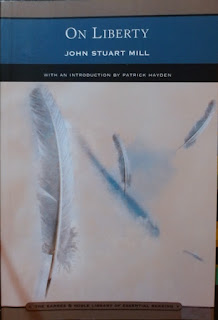
Review of On Liberty by John Stuart Mill

This review was written by Eugene Kernes

Book can be found in:
Genre = Philosophy, Epistemology
Book Club Event = Book List

Watch Short Review

Excerpts

“Society can and does execute its own mandates: and if it issues wrong mandates instead of right, or any mandate at all in things with it ought not to meddle, it practices a social tyranny more formidable than ay kinds of political oppression, since, though not usually upheld by such extreme penalties, it leaves fewer means of escape, penetrating much more deeply into the details of life, and enslaving the soul itself.” – John Stuart Mill, Chapter 1: Introductory, Page 5
 
“The opinion which it is attempted to suppress by authority may possible be true.  Those who desire to suppress it, of course deny its truth; but they are not infallible.  They have no authority to decide the question for all mankind, and exclude every other person from the means of judging.” – John Stuart Mill, Chapter 2: Of The Liberty Of Thought And Discussion, Page 17
 
“Yet it is as evident in itself as any amount of argument can make it, that ages are no more infallible than individuals; every age having held many opinions which subsequent ages have deemed not only false but absurd; and it is certain that many opinions, now general, will be rejected by future ages, as it is that many, once general, are rejected by the present.” – John Stuart Mill, Chapter 2: Of The Liberty Of Thought And Discussion, Page 18

Elaborate Description

Overview:

An attempt to define what power society has over an individual.  There is reciprocity between the individual and society.  Being part of a group has benefits, which individuals should be willing to adhere to the societies provisions whether they are legal, or are a tacit understanding.  Rules such as not to harm the interests of other members in the society.  But government and society can abuse their powers, and cause harm to those they are meant to support.  A key freedom is the ability to disagree, which usually has social and political consequences.  Ideas benefit from being tested by diverse opinions coming from a variety of human backgrounds and experiences.  By allowing dissent, the problems within the ideas can be recognized and then rectified, for no idea has a monopoly on truth.  Ideas and society benefit from considering different sources.  Society becomes more valuable with the diversity of experiences, the uniqueness of each individual.

Governments have power.  Power that can be used against enemies and citizens alike.  Limitations on that power are needed to prevent its abuse against the very people it is meant to support.  Preventative powers are especially subject to abuse.  When government restricts something, the restriction tends to apply for the outcomes that hurt and help people.  Another reason for a limitation on the interference of the government is to prevent everyone from becoming depended on government.  Looking to government for all of life’s answers means people cannot be free.

There are many ways to modify behavior than physical punishments.  Society itself can become a tyrant, through the use of public authorities, creating tyranny of the majority.  Social tyranny that can be more powerful than official authoritative power.  Society can impose extreme penalties, while limiting escapes, and effects how life is lived.  Individuals are accountable to their society for their actions and inactions which harm others.  Although accountability to inaction should be cautioned.

Action should not be as free as opinion.  Even opinions have limitations when they instigate mischievous acts.  Acts that harm others without justifiable cause, should be condemned to unfavorable sentiments and have an intervention.  To have a limitation is to prevent an individual from being a nuisance to others.   

Those who disagree are possibly correct in their views.  Those who deny the views of others are not infallible.  Every era is as fallible as the others.  Every era had ideas which subsequent eras deemed false or worthy of ridicule.  Many ideas of the present are just as likely to be rejected by successors.  Many ideas deemed valuable have been previously persecuted.  Persecuting ideas can prevent them from spreading, holding back their understanding.  Ideas will perpetuate as long as those who espouse them are large enough to not be easily persecuted.  Nobody has the power or authority to decide what everyone else should think, or exclude them from judging for themselves.   

Facts rarely speak for themselves.  Their meaning needs to be communicated.  Ideas adept to the times they are in.  Improving and mixing with other ideas.  Ideas might not be completely accurate, but they should not be silenced for all their errors.  It is within the collision of adverse opinion that the idea can gain accuracy.   

Attempts to refute an idea is the very reason the idea can be deemed worthy, as they can be better than the alternatives.  The value of human judgment is to rectify the wrong ideas.  Ideas need to be challenged from varied sources, and diverse experiences.  As people who come from different backgrounds will engage with the idea differently.  There are many who value discussing ideas freely, but nevertheless hold some ideas as infallible, and arguments are inappropriate.

Support generally goes to those who argue in favor of an idea working, while disparaging those who are critical of the idea and point out its weaknesses.  The evolution of ideas depends on ideas that work, but thinking about the idea’s problems, errors, and practicality are highly valuable for what ideas survive. 

To properly instruct future generations of most the valuable ideas and behaviors, there needs to be freedom of the press.  The ability to write and publish without restrain.  As this freedom will allow instructors to know what they need to know.   What prevents people from understanding some ideas is the lack of experience.  As experience makes the idea personal.  Other ideas are not understood because the individual was not prepared to understand them.  Ideas do need to be accustomed to.  

Humans can develop better behavior over time.  By developing an individuality, the person becomes more valuable to oneself and others.  Diversity of human experiences brings more fullness to life.


Caveats?

The book can be very difficult to read partly because of the era in which it was written in, and partly because of style.  The author creates a lot of philosophical paradoxes.  While decrying intolerance to hearing alternative view, the author can be very intolerant to other views.  But the limitations with the book are subject to modifications, which can improve the ideas held within.  


Questions to Consider while Reading the Book

•What is the raison d’etre of the book?  For what purpose did the author write the book?
•What power does society have over an individual?
•What are the benefits of being in a group?
•What are some social rules?
•How and why do governments and society abuse their power? 
•What is the freedom to disagree?  Why does it matter?
•How do ideas evolve?
•Why limit government power?
•What is the tyranny of the majority?
•What are the limits to behavior?
•What are the limits to opinions?
•Should ideas go to the extreme? 
•What happens when certain views and ideas are persecuted?
•Which views are right and which are wrong?  How can someone tell?
•What views benefit and hurt society?
•How do humans change? 

Book Details
Edition ISBN:  9780760755006
Pages to read:   136
Publication:     2004
1st Edition:      1859
Format:           eBook

Ratings out of 5:
Readability    2
Content          5
Overall           4

Tuesday, February 8, 2022

Review of Go Ask the River by Evelyn Eaton

This book review is written by Eugene Kernes

Book can be found in:
Genre = Novel, History
Book Club Event = Book List
Intriguing Connections = 1) Tales of Growing Up,

Watch the Review


Elaborate Review

Overview:

This is a fictionalized account of the life of the poet Hung Tu who lived during the Tang Dynasty.  Containing many of Hung Tu’s poems.  Bearing the heart, soul, and intellect of the poet.  For poets like Hung Tu, are very observant, and cunning in their words.  This is more than just a story as it uses the culture and social organization of China during the time.  The story itself is about the whole turbulent life of Hung Tu.  From how and why the family moved from the capital to the calamity of bandits.  From being sold to a Blue House, to working for governors.  But rewards of the struggles endured are tenuous, with calamity striking again and again.  A poetic portrait of the vicissitude and complexity of life.  The uncertainty of potential outcomes in a variety of decisions.  Hung Tu was brilliant with words, but that was hard to show in a patriarchal society.  But many of the lessons learned facilitated in refining skills in observation and judgement that would be greatly valued in time.  


Caveats?

The transitions between the different times of Hung Tu’s life have poor narrative transitions, making it a bit difficult to read and prevents flow within the narrative.  As this book contains cultural aspects and traditions, many of the cultural traits can be missed without their prior knowledge.  This info would help readers understand the background ideology and decision making.  


Questions to Consider while Reading the Book
•What is the raison d’etre of the book?  For what purpose did the author write the book?
•What are some limitations of the book? 
•What poems interest you?
•What are the religious and philosophical themes in the book? 
•What is the role of scholars in this era?
•What is the role of women in this society? 
•What is a Blue House? 
•Who is Face-from-the-River?
•How do officials behave?
•How does court and status behavior differ from everyday behavior? 
•What changes occur over time?
•Why did Hung Tu’s family leave the capital?
•How is Hung Tu treated in her family? 
•What happens to Hung Tu’s family? 
•How did Hung Tu obtain the skills of a poet?
•How does Tall Bamboo operate the Blue House?
•How did bandits impact life?


Book Details
Edition ISBN:  9780857010759
Pages to read:   261
Publication:     2012
1st Edition:      1969
Format:           eBook

Ratings out of 5:
Readability    4
Content          4
Overall           4


Thursday, February 3, 2022

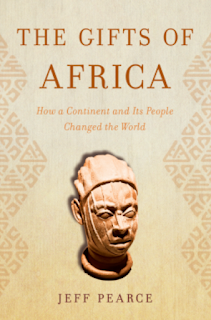
Review of The Gifts of Africa: How a Continent and Its People Changed the World by Jeff Pearce

This review is written by Eugene Kernes

Book can be found in:
Genre = History, Empires

Watch Review

Elaborate Description

Overview:

Africa is a diverse place that has a long history of political maneuverings, cultural traditions, philosophy, art, science, medicine, and economics.  Africa was where the wealth and power was in the ancient world.  This intellectual history is usually not recognized because it does not seem very African.  Only seems that way after many of the artifacts were stolen or destroyed, leaving no trace of the rich history.  Part of the reason is because Africa has a deep oral tradition, which informs decisions and keeps behavior accountable to future generations, but is in question because of the fragility of memory.  This book reorients African history to be about Africa, rather than as part of a description of the West.  Africa had contact with various cultures.  They even had a code of chivalry.  Even when considered mystical figures, rulers knew their limits.  This is a book of how various individuals from different backgrounds have influenced the world through their work.  From the wealth of Egypt to the resistance and activism of the early 21st century.


Caveats?

The book is sometimes difficult to read.  Although the author is correcting a bias, the author also has a bias.  What the bias indicates is a need to figure out how to talk about Africa without dismissing African achievements and hardships, while seeing how Africa influences and was influenced by the world.  


Questions to Consider while Reading the Book
•What is the raison d’etre of the book?  For what purpose did the author write the book?
•What are some limitations of the book? 
•How is Africa usually described?
•How did Africa influence other cultures?
•How was Africa influenced by other cultures?
•Who did Africa have contact with?
•What intellectual pursuits were there in Africa?
•What kind of wealth was in Africa?
•Why was Africa being dismissed of its history?
•What political organization systems were in Africa?
•Why was there a slavery institution?
•How did Africa interact with the West?
•Who are the activists and for what causes did they have? 
•What are some African terms? 

Book Details
My edition was provided by NetGalley
Edition ISBN:  9781633887701
Pages to read:   464
Publication:     2022
1st Edition:      2022
Format:           eBook

Ratings out of 5:
Readability    3
Content          4
Overall           4

Tuesday, February 1, 2022

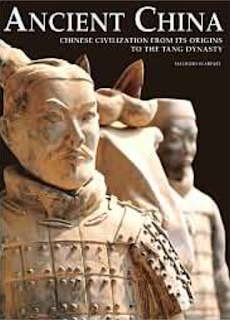
Review of Ancient China: Chinese Civilization From Its Origins To The Tang Dynasty by Maurizio Scarpari

This book review is written by Eugene Kernes

Book can be found in:
Genre = History, Empires
Book Club Event = Book List

Watch Short Review

Elaborate Review

Overview:

This is a museum in a book.  The cultural building blocks of China.  Showcasing not just the various aspects of ancient Chinese culture, but the very artifacts from the time period.  Chinese considered their region as the center of the world, the Middle Kingdom.  Usually organized by a system of kingship whose ambition was to conquer and unify everything under Heaven.  Dynastic rule was based on divine authority.  Depending on the behavior and conduct of the rulers, they might lose or gain the favor of Heaven.  A Mandate from Heaven that could be used to legitimately overthrow a dynasty.  Many of the glories of the dynasties, came about because of the efforts of prior dynasties.  Honor between adversaries was to be upheld during battle and after.  Mercy was not uncommon.  Although wanting to influence other peoples, China itself was heavily influenced by other cultures and ideas, such as with Buddhism.

Earlier rule was based on Shaman-priests, a class dominating politics from a magical-religious influence.  Technology during this era was directed at ritual items, rather than improving everyone’s lives.  Divination gradually lost its central role in worship, changing where resources were directed to.  Political organization shifted bureaucracy gradually from family bonds, to merit.  Bringing further coordination from local governments by a system that facilitated extensive central control.

Unified by 221 B.C.E. under the Qin dynasty.  Even with various political vicissitudes, it was an empire that persisted though many centuries, until 1911 C.E.  Many works such as philosophy, literary, and historic were burned by the Qin.  The works held traditions, which were obstacles to implementation of new plans.  Annals of Qin, and scientific treaties were excluded from the destruction.  The Qin dynasty did not survive past its founder, as a power struggle tore the government apart.  

But it is not only purposeful destruction that contributed to the scarcity of artifacts, it was also time.  Little has survived the ravages of time, as most architecture were constructed using perishable materials.

China has a history of extreme inequality.  During certain times, they allowed enslaving peasants.  With peasants generally losing more and more land, and therefor having to work for large landowners.  Elites had most of the resources, while the rest lived in poverty.  Luxury products were produced with the resources that the elite had.

Chinese had various mystic and philosophical understandings that coordinated behavior.  Confucianism focused on family ties.  Learning about past values, culture, and improvement of oneself were tools for moral progress and how harmony is generated from social conscience.  Daoist focused on the individual rather than society.  Aspiring to a simple existence devoid of ambition.  Within these mystical ways, the individual would be capable of liberation from the physical world.

China wanted to assimilate people outside their lands, but China itself was influenced by foreigners.  Buddhism was quickly integrated into Chinese civilization.  A massive effort between Chinese and Indian monks to translate the Sanskrit texts.       


Caveats?

The book covers a very long period of time, with many changing aspects.  As such, the book is limited in creating an in depth understanding of any given era.  What is also limited are the interconnections between ideas and topics.  The book works well as an introduction to Ancient Chinese culture, but more research will be needed to understand how the various cultural aspects fit together, and the reasons behind many of the changes.  

Claims are often made without much detail or explanation making it difficult to accept.  Some claims might have been passed down, while the details have been destroyed with time.  A claim made without much explanation includes the continuity of the empire, given the various dynastic breakups, and China itself being conquered.  What is missing, due to lack of space, are the various interpretations of the ideas.  


Questions to Consider while Reading the Book
•What is the raison d’etre of the book?  For what purpose did the author write the book?
•What are some limitations of the book? 
•What artifacts do you find interesting? 
•How was ancient China politically organized?  How has the organization changed?
•When was China unified? 
•What was the impact of the Qin?
•What is the Mandate of Heaven?
•What are ancient Chinese philosophies and religions? 
•How was ancient China influenced by foreigners?  
•What threats did ancient China face? 
•What survived the ravages of time?  What did not survive? 
•How was social life during ancient China?

Book Details
Edition ISBN:  9780760783795
Pages to read:   275
Publication:     2006
1st Edition:      2000
Format:           Hardcover

Ratings out of 5:
Readability    4
Content          4
Overall           4