This book review is written by Eugene Kernes
Genre = History
A library consists of the books you have read. An anti-library are all the books which you have not read.
This book review is written by Eugene Kernes
This review was written by Eugene Kernes
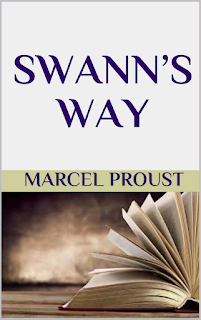
“The truth was that she could never make up her mind to purchase anything from which no intellectual profit was to be derived, and above all, that profit which good things bestowed on us by teaching us to seek our pleasures elsewhere than in the barren satisfaction of worldly wealth.” – Marcel Proust, Overture, Page 40
“Unfortunately, having formed the habit of think aloud, she did not always take care to see that there was no one in the adjoining room.” – Marcel Proust, Combray, Page 51
“He did not, however, draw her attention to this inconsistency, for he thought that, if left to herself, Odette might perhaps produce some falsehood which would give him a faint indication of the truth.” – Marcel Proust, Swann In Love, Page 287
Overview:
Told with reminiscence.
Looking back on life’s events, which includes the family friend Charles
Swann. Containing the narrator’s
thoughts during the events. From times
of getting into trouble and the unexpected consequences. To reading experiences and the sources of
pleasure. From family life and the
complexity of bonds. To falling in love
and being jealous. Thoughts that contain
the strategizing before an event, to get an appropriate response, and the
varied results that ensue. Each event holds more than just what can be
observed. Along the way is an eclectic
array of information and philosophy. Thoughts
on history, and the changing times. The
interplay between ideas and their impact on decisions made. But what happened in the past cannot be
changed, and the decisions made have to lived with. Rationalizations of the past have their
limitations.
Caveats?
This is a very tedious book to read, containing poor
transitions between ideas. But, the
book’s writing is very consistent with the subject, unfiltered thoughts. Which makes it feel authentic.
This review was written by Eugene Kernes
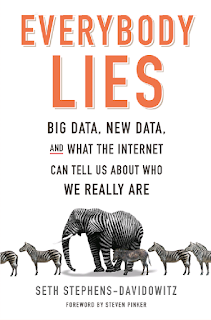
Overview:
Human thoughts are very complex, making many different ways
to access them subject to a variety of limitations. Big data via the internet is very revealing
about people. What people search for is
information that can reveal what they are thinking about. Providing a different way to learn about
people. There are four ways that big
data adds value to research which are 1) new types of data, 2) honest data, 3)
zoom on small subsets, and 4) generate causal experiments. The internet is a primary source of data that
uses messy traces, unlike traditional sources of data such as surveys and
questionnaires which are very neat. Big
data has many limitations as well, but it can help in a variety of situations. A problem with big data is that as it enables
better predictions about human behavior, the information can be misused by
corporations and governments leading to various forms of nefarious
discrimination activities.
People tend to be way more honest in their search terms rather than what they claim about themselves. Depending on the context, they can be honest because of potential consequences, or because there are no consequences. Surveys are usually anonymous, but people still lie on them because they want to look good. The desirability bias causes people to lie about who they are relative to who they want to be. Impersonal data tends to be more honest. People will confess when they are alone rather than in the presence of others. Facilitates knowing what people do rather than say they do.
Big data facilitates better understanding of the topics which can lead to better resolution methods. Big data reveals that individuals are not alone in their insecurities and embarrassing behavior. Making overt covert suffering. Google data can highlight many vulnerable people, as they might not want to report their trauma to official sources.
Offline experiments are time consuming and costly. The digital space enables cheap and fast randomized experiments. Gaps in understanding can be filled by testing. Gaps always exist.
Big data has limitations. The numbers measure what can be gathered, not necessarily what is wanted or important. Models created from the data does not indicate the reason why the model works. Knowing why models work may not be that important. But with this limitation, there is no indication of insights that can be gained and ways to improve understanding of the topics. There are data sources in which do facilitate lying rather than honesty. When there is no incentive to tell the truth, people make themselves appear better. Online presence is not always anonymous, and can cater to an audience.
Caveats?
The book is well written with plenty of examples and provides a general understanding of the power and complexity of big data. There are many topics in this book which are very sensitive, as in very private and personal. As such, the book may not be appropriate for minors.
Although big data
does open up more opportunities to consider how people think, what matters is how
the data is interpreted. There are a
variety of interpretations of the data, of which there can be many misleading
interpretations. Big data does offer
lots to think about, but not how to think about what it
brings up.
This review was written by Eugene Kernes
Elaborate Description
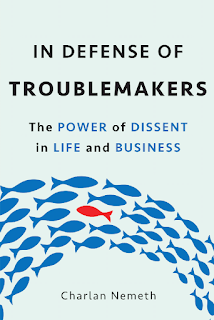
Overview:
This is a book on how to raise decision making quality. While searching for consensus hurts decision making, dissent improves decision making. Assuming the majorities claims narrows thinking and creates poorer decisions. People speak from the majorities perspective even if the individual is not part of the majority. Dissent broadens thinking by opening up alternative perspectives. The benefits of dissent are that thinking becomes more divergent, creative, and creates a search for information about the claims raised. A reason for not raising alternative ideas is the fear of being ridiculed or rejected. There are ways to reduce persecution such as anonymity. Dissent should not be created for its own sake, but should be permitted and embraces when it is present. By not speaking up, the group suffers and misses opportunities. What matters for the dissenter is how to argue their ideas, as their ideas allow the group to see those different opportunities, some of which can be much better.
Consensus is a problem when it goes unchallenged. When the majority has a position, they influence just because of their numbers. Facts matter little when people think that the number of people who believe something are more likely to be correct. People can follow the majority whether it is correct or wrong. Majorities get public agreement without the people believing the majority position.
Dissent provides value, even when it is wrong, as it breaks blind following of the majority, and it motivates consideration of alternatives. Dissenter minority voice influences by reason. Persuasion by dissenter is time consuming, usually indirect, and contains an artful argumentative style. Consistency in the dissenter is needed for persuasion, but it is not sufficient. Dissenters change minds in private rather than publicly. People tend to agree with dissenters in private, but resist in public.
Playing devil’s advocate does not necessarily work because its not authentic dissent, and as such does not stimulate divergent thinking. Not criticizing others ideas is not a good tactic as it prevents consideration of the alternatives.
Caveats?
This book is well written to support those who think differently. Some caveats of the book include research quality and support for dissent.
Research that is meant to support the claims have mixed quality. Some are practical and can be applied to real life, others are to abstract to be appropriate supports of the claims made. The research needs to be considered more carefully before applying some of the claims.
This book is very partial in disapproving majority thinking, while only supporting dissent. Although the reasons to favor listening to dissenters and questioning majority are marvelous, it does reduce the complexity of real life which can prevent appropriate application. There are reasons that people dissent which does not add value to decision making. The dissenters can have their own motivations which are not for the benefit of the majority, and prevent majority decision which can help the many. Sometimes dissenters can prevent quality decision making by the majority by coming up with erroneous alternatives. Too much dissent can be problematic as well.
There is an attempt in making a case for how to go about with a dissent, but it needs a lot of work as there are many ways in which a dissenter who is right can project their views in a manner that makes them appear wrong. As in, the way a dissenter presents the information, the dissenter can prevent a search for information rather than inspire the search.