Friday, March 18, 2022

Review of Charlie and the Chocolate Factory by Roald Dahl

This review was written by Eugene Kernes

Book can be found in:
Genre = Novel
Book Club Event = Book List
Intriguing Connections = 1) What Happens Next?: Series (Charlie Bucket), 
Watch the Review

Review

Overview:

Willy Wonka is the greatest chocolate maker in the world.  Wonka created many inventions deemed impossible.  But was going to be ruined by spies taking Wonka’s secrets.  In response, Wonka closed the chocolate factory.  After some time, when the factory was reopened, the chocolate factory made its dazzling chocolate varieties, but nobody went into or out of the factory.  But later on, Wonka decided to let in 5 children to tour the factory.  The children will be those who got a Golden Ticket.  For those with a Golden Ticket, meant not only a tour of the factory, but a lifetime supply of chocolate, and a special prize to one of them.  The world was in fervor trying to get the tickets.  One of the Golden Ticket’s, miraculously went to Charlie Bucket.  Whose family was subsisting on a very small income.  A small income that needed to be shared by seven people.  Barely could afford Charlie’s only Wonka Bar a year for Charlie’s birthday.  

This is a story teaching morals.  Showcasing how to act and behave appropriately.  That being humble and listening are rewarded.  That acting out without considering the consequences leads to terrible results.  That thinking differently facilitates curiosity about things that others would deem impossible.  


Caveats?

The book is really easy to read.  This is a children’s book, and forces a suspension of beliefs about what is possible.  With some event sequence inconsistencies.  


Questions to Consider while Reading the Book

•What is the raison d’etre of the book?  For what purpose did the author write the book?
•What are some limitations of the book?
•Who is Willy Wonka? 
•What happened to Wonka’s chocolate factory?
•What are some stories surrounding Willy Wonka?
•Who are Willy Wonka’s workers?
•How large is Willy Wonk’s chocolate factory?
•Who is Charlie Bucket?
•Who are the children that get a golden ticket?  What are their personalities?
•What lessons are learned throughout the book?

Book Details
Edition ISBN:  0140328696
Pages to read:   160
Publication:     1988
1st Edition:      1964
Format:            Paperback

Ratings out of 5:
Readability    5
Content          3
Overall           4


Monday, March 14, 2022

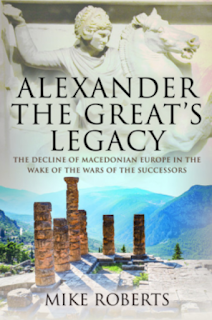
Review of Alexander the Great's Legacy: The Decline of Macedonian Europe in the Wake of the Wars of the Successors by Mike Roberts

This book review is written by Eugene Kernes

Book can be found in:
Genre = History, Empires

Watch Review

Review

Overview:

Macedonia was a small state until it became a great power.  This book follows the course of the breakup of Macedonia.  How Alexander the Great’s power fractured and weakened.  This was the legacy that Alexander the Great had left behind.  Showcasing those who took power, and their successors.  The reasons why they wanted power, and how they kept or lost it.  The political maneuverings.  The different cultures and attitudes that people had towards others. 


The lack of unity caused friction between the kingdoms.  The fractured Macedonian kingdoms were weaker than their former whole self.  Being weakened, and having to deal with internal struggles, made them targets of foreign powers.  There were many vicissitudes of power.  Strategies that had worked and were deemed superior, had their flaws found and become ineffective. 


Caveats?

This book has a lot of details, the problem is how they are expressed.  Easy to lose track of which details apply to whom and what region, because the details quickly relate to various people and regions.  Hard to understand how the details go together.  To get a lot out of the book, the reader needs to already know a lot about the background of the various people and regions.  


Questions to Consider while Reading the Book

•What is the raison d’etre of the book?  For what purpose did the author write the book?
•What are some limitations of the book?
•How did Macedonia gain power?
•Why did the Macedonian empire fracture?
•Who took power after Alexander the Great?
•What is Alexander the Great’s Legacy?
•What were important military strategies?

Book Details
This book was provided by NetGalley
Edition ISBN:  9781526788528
Pages to read:   283
Publication:     2022
1st Edition:      2022
Format:           eBook

Ratings out of 5:
Readability    1
Content          1
Overall           1


Friday, March 11, 2022

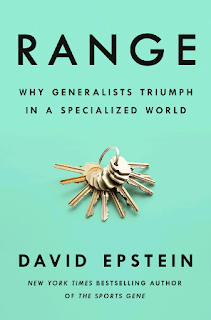
Review of Range: Why Generalists Triumph in a Specialized World by David Epstein

This review was written by Eugene Kernes

Book can be found in:
Genre = Economics, Behavioral
Book Club Event = Book List

Watch Short Review

Elaborate Review

Overview:

To have high performance in a field, there is a lot of promotion for early specialization.  That the successes of early specialization within fields such as chess and golf, can be applied to other areas.  But there is an assumption within these successes, that the learning environment is kind.  Kind learning environments are those in which patterns repeat as the rules stay the same, and feedback is accurate and rapid.  While in wicked domains, rules are unclear or incomplete, a lack of repetitive patterns, and feedback is delayed or (and) inaccurate.  When rules and answers are known and are stable, then hyperspecializing can be beneficial.  But that is a poor model for most things that humans want to engage in.  Those who have late start to specialization, learn a multitude of skills and abilities which they can later rely on.  There are many people who had late starts, which did not hold them back.  Late starts were integral to their success.  Creativity can be sparked by having a range of knowledge.  In many creative fields, solutions or ideas come from different fields.  They come from an outsider, as the insider’s views were too constrained.  Specialized knowledge is narrow and not flexible, which means that it cannot apply well to other domains.  Experts are well prepared for what they have already experienced, but fail at everything else.   

High performers in kind learning environments create a false impression that human skill is often done in kind learning environments.  Early practice and specialization does not even help in most sports.  Elites of sports tend to sample different sports before devoting a lot of time to a single sport.  In that sampling period, they obtain various physical proficiencies which they can use in their specialized sport.  When sampling, they also find the sport that actually interests them.  They find out about their abilities and proclivities.  It is by interacting with the world, by living, that people find about who they are.

Answers are easy when there are definite solutions and the questions are known.  The problem is in fields in which they are still trying to ask the right questions.  Uncertain environments and wicked problems need breath of experience.  Specialization is useful for kind problems.  The problem is applying specialized skills in a kind environment, to wicked environments.  That can lead to disaster.  People tend to use the same tools that they have habituated too, even when the situations are completely different.  It is difficult to drop familiar tools.  Becoming an overlearned behavior.

Experts traded flexibility for narrow skills.  Non experts have an easier time adapting to new rules than experts.  This phenomenon is called cognitive entrenchment.  To become more flexible, people need to vary challenges within their domains.  Having some attachments outside to the specialized field.

Abstract thinking allows individuals to rely less on personal experience as a reference point.  Conceptual classifications facilitate connections to different information, making knowledge accessible and flexible.  Much of work in the digital era requires knowledge transfer, as knowledge needs to be applied to different domains and new situations.  Need to develop habits of mind to consider what other disciplines have to offer.  Detailed knowledge of a question can be less important than the way to think about the question.

Too much specialization within intellectual fields can cause the individuals to become too narrow minded, that it causes them to become worse with experience, while more confident.  People within the field tend to pick and choose data that supports their view, making their knowledge work against them.  Extreme views can be created from considering more internal details.

Usually, it is thought that hyper specialization drives innovation, but what specialization does is create opportunities for outsiders.  Elevating narrowness is an ideal can be very counterproductive.  Specialization can become so constrained, that only an outside can see the solution.  Creative problem solving can come from outsiders who use different approaches.  Merging available disparate information is undiscovered public knowledge. 


Learning:

Effective Learning occurs during a slow accumulation of lasting knowledge.  Immediate progress is not an indicator of future potential.  Struggling to understand something is frustrating, but leads to durable understanding.  Quick and easy is a problem in learning, because it makes the lesson temporary.  Desirable difficulties make learning challenging, slower, and frustrating for immediate situation, but have better outcomes.  Excessive hint-giving benefits immediate performance, but hurts progress in understanding.

Performing poorly on tests can provide a lot of feedback that can be used to improve the knowledge base.  Tolerating mistakes creates learning opportunities, as reconsidered responses tend to be remembered better.


Caveats?

The book is easy to read and has a complex view of specialization.  The problem is defining how much range in skills and knowledge is needed, and what it means to be a late started.  How late an individual should specialize seems like an indeterminant time frame than the easy framework of early specialization.  Much like there is a survivorship bias in success for specialists, there is a survivorship bias for late starters and general knowledge.

The book is primarily composed of examples.  As the book is about range, the examples are diverse.  The problem is how to put their meaning together, to make them general knowledge rather than just specific within a dominant.  


Questions to Consider while Reading the Book
•What is the raison d’etre of the book?  For what purpose did the author write the book?
•What are some limitations of the book?
•Why promote early specialization?
•What do late starts do?
•What does it mean to have range of knowledge or skills?
•What are kind learning environments?
•What are wicked domains? 
•Who wields the appropriate solutions?
•Why does specialization create opportunities for outsiders? 
•What are experts good at?
•What is the purpose of a sampling period?
•How does having more insider’s information about a problem impact views?
•How do experts and non-expert’s adept to new situations? 
•What is the impact of abstract thinking? 
•What are some learning techniques? 
•What is the Moravec’s paradox? (Role of machines.)
•What are tests for? 
•What is the end of history illusion? 
•What is the difference between hedge hogs and foxes? (Expert mind-sets.) 
•How does becoming more urban (modernizing) change the way people think? 


Book Details
Edition ISBN:  9780735214491
Pages to read:   270
Publication:     2020
1st Edition:      2019
Format:           eBook

Ratings out of 5:
Readability    5
Content          5
Overall           5


Monday, March 7, 2022

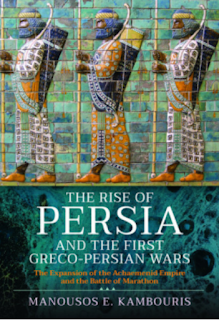
Review of The Rise of Persia and the First Greco-Persian Wars: The Expansion of the Achaemenid Empire and the Battle of Marathon by Manousos E. Kambouris

This book review was written by Eugene Kernes

Book can be found in:
Genre = History, Empires
Watch the Review

Review

Overview:

Sources about the Persian Empire are scarce and often biased in favor of some peoples over others, creating a distorted account of events.  The author attempts to corroborate sources, and rectify the errors, to make an account of the events and battles as they actually happened.  The focus of the book is on the battles and wars.  The weapons and tools that were available.  The tactics and strategies employed.  Naval and land capabilities.  

Greek city-states and the Persian Empire had some similarities, such as the need for resources outside those that were available in their regions.  The way they obtained those resources was different.  While the Greek city-states created colonies, the Persian Empire conquered regions. The decentralized system of the Greek city-states created friction, as their differences did not mix well.  The centralized system of the Persian Empire was able to make bureaucracy more systematic, such as with taxation, but created a problem with rebellions, as people did not want to give up their freedoms.  Showing the cultural attitudes toward others, and the importance of geopolitics, as the people who could offer valuable services were favored, while others were under pressure.  


Caveats?

The writing of the book is difficult to understand without knowing a lot of the background information.  The book is detailed, but hard to put together without knowing the cultural forces impacting decisions.


Questions to Consider while Reading the Book
•What is the raison d’etre of the book?  For what purpose did the author write the book?
•What are some limitations of the book?
•Why is the history of the era difficult to put together?
•What are the weapons that were available?
•What strategies were used?
•How were the Greek city-states organized?
•How was the Persian Empire organized?
•What were some important battles?
•Why did the regions fight?
•What were some cultural attitudes?

Book Details
Edition ISBN:  9781399093293
Pages to read:   215
Publication:     2022
1st Edition:      2022
Format:           eBook

Ratings out of 5:
Readability    2
Content          2
Overall           2


Friday, March 4, 2022

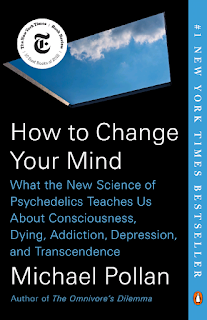
Review of How to Change Your Mind: What the New Science of Psychedelics Teaches Us about Consciousness, Dying, Addiction, Depression, and Transcendence by Michael Pollan

This review was written by Eugene Kernes

Book can be found in:
Genre = Psychology
Book Club Event = Book List
Intriguing Connections = 1) How Products Shape and Change the World, 

Watch Short Review 

Elaborate Review
Overview:
Psychedelics have a lot of research potential, but the negative press during the 1960s prevented further investigation of the benefits.  Forced the research to go underground.  Psychedelics were linked with bad decision making.  But research in psychedelics are making a comeback.  This is a story about the people and experiences involved in the psychedelic resurgence.  The research involved, the psychedelic guides, and the experiences after taking the psychedelics.  Experiences with psychedelics are all different, because they depend on the expectations that one brings to the experience.  Magnifying what is going on inside and outside one’s head.  Experiences get more questions than answers, but the answers were durable.  A powerful and lasting experience.  Psychedelics change how the mind process information.  The experiences appear to temporarily remove the ego, while making a person more creative. 

The brain is a very complex system.  To understand the brain, scientists can disturb it with psychedelics and watch what happens to the brain’s activity and patterns of connection.  What research shows is that psychedelics slow activity in the main node networks of the brain.  Temporarily removing the barriers between the ego and the world.  While simultaneously the brain intergrades new connections.  Becoming more creative.  The brain becomes more flexible and interconnected under psychedelics.

Psychedelics appear mostly harmless.  More frightening than dangerous, and are not addictive.  Repeat use reduces the effect of the drugs.  The experiences can be terrifying, and mental illnesses can be exacerbated.  

As psychedelics changes the way the brain operates, there is theory that it was psychedelics that accelerated human evolution.  Turning humans into thinking beings capable of language.  

Caveats?
The writing is hampered by poor organizational structure.  Trying to tell about the people involved, while explaining psychology, and the history but neither gets enough attention which can prevent an understanding.

Questions to Consider while Reading the Book
•What is the raison d’etre of the book?  For what purpose did the author write the book?
•What are some limitations of the book?
•What are some psychedelics?
•Why was psychedelic researched banned?
•Why is psychedelic research making a resurgence?
•Who is responsible for the resurgence of psychedelics?
•Why study psychedelics? 
•How do psychedelics impact the brain?
•What are the outcomes of psychedelics?
•Are psychedelics dangerous?
•What do psychedelic guides do? 
•How did Timothy Leary do to psychedelic research? 
•How did the government use psychedelics? 
•How does big pharma and psychiatry deal with psychedelics? 
•Did psychedelics impact human evolution? 

Book Details
Edition ISBN:  9780525558941
Pages to read:   333
Publication:     2018
1st Edition:      2018
Format:           eBook

Ratings out of 5:
Readability    3
Content          3
Overall           3