Showing posts with label Law. Show all posts

Saturday, September 19, 2026

Review of Law, Justice, and Power: Between Reason and Will edited by Sinkwan Cheng

This book review was written by Eugene Kernes   

Book can be found in: 
Genre = Law


Watch Short Review

Excerpts

“According to David Hume and J. S. Mill, questions of justice arise in conjunction with conflicts of interest.  Had it not been for the limits to human benevolence and the competition for scarce goods, justice would not have been an issue.  Justice impacts on our consciousness most concretely when people press claims and justify them by refence to a set of rules.” – Sinkwan Cheng, Introduction, Page 1


“The intricate relationship between law and justice becomes infinitely more complex when power is brought on stage.  A consideration of power is indispensable because, whatever ideas we have about law and justice, it is power that makes a real difference in the world – be it catastrophic or providential.  Power, in other words, reveals both the oppressive and benevolent faces of the law.  Only through power can law act as an oppressive apparatus.” – Sinkwan Cheng, Introduction, Page 3


“For law to rule, it has to be comprehensive in its potential range.  It has to be able to do anything, if not everything.  It cannot, then, simply secure stability and predictability but also has to do the opposite: it has to ensure that law is ever responsive to change; otherwise, law will eventually cease to rule the situation that has changed around it.  So how could the rule of law be complete if it must ever respond to the infinite variety of fact and circumstance impinging on it?  How could it be closed when it must hold itself constantly responsive to all that is beyond what it may at any moment be?” – Peter Fitzpatrick, Chapter 10: Law in the Domains of Death, Page 210


Review

Is This An Overview?

Justice is needed to resolve conflicts of interest.  With the competition for scarce resources, justice provides a method of managing expectations through agreed upon rules.  But rules need to be enforced, which requires power.  Power determines whether the law becomes oppressive or benevolent.  Justice needs force, but force without justice is tyrannical.  Having power, does not mean that those who wield power, can do all that is possible with the power.  Those who have power have overridden laws and justice by claiming a moral duty to their actions. 


Laws provide stability and predictability, but also change.  To retain the rule of law, laws need to constantly respond and adapt to changes around laws.  But there are infinite variations of facts and circumstances that prevent laws from becoming a complete guide to justice.


Caveats?

This book is a composition of various authors.  Although each author has their own writing style, the book is generally difficult to read.  The authors use abstract language, that requires a background in law and philosophy to decipher appropriately. 


The authors often use very short examples as evidence of a claim, but those examples are not given much context.  Making the example liable to different interpretations based on missing details.  The reader is expected to know a diverse set of examples throughout history.


Questions to Consider while Reading the Book

•What is the raison d’etre of the book?  For what purpose did the author write the book?  Why do people read this book?
•What are some limitations of the book?
•To whom would you suggest this book?
•Why is there a need for justice? 
•What is the effect of power?
•What are the limits of power? 
•How are laws enforced?
•How does moral duty affect laws?
•How did NATO affect Kosova? 
•What is sovereign speech?
•How does ethics affect laws?
•Can laws be complete?

Book Details
Chapter Authors:   Alain Badiou, John Brigham, Sinkwan Cheng, Peter Fenves, Peter Fitzpatrick, Nancy Fraser, Robert Gibbs, Martti Koskenniemi, Julia Kristeva, Ernesto Laclau, Juliet Flower MacCannell, J. Hillis Miller, Maggie O'Neill, Slavoj Žižek
Publisher:               Stanford University Press
Edition ISBN:         9780804748919
Pages to read:          269
Publication:             2004
1st Edition:              2004
Format:                    Paperback 

Ratings out of 5:
Readability    1
Content          2
Overall          1


Sunday, June 14, 2026

Review of Justice: What’s the Right Thing to Do? by Michael Sandel

This book review was written by Eugene Kernes   

Book can be found in: 
Genre = Law
Book Club Event = Book List (06/20/2026)


Watch Short Review


Excerpts

“To ask whether a society is just is to ask how it distributes the things we prize – income and wealth, duties and rights, powers and opportunities, offices and honors.  A just society distributes these goods in the right way; it gives each person his or her due.  The hard questions begin when we ask what people are due, and why.” – Michael Sandel, Chapter 1: Doing the Right Thing, Page 20


“One way of understanding what Kant means by acting autonomously is to contrast autonomy with its opposite.  Kant invents a word to capture this contrast – heteronomy.  When I act heteronomously, I act according to determinations given outside me.  Here is an illustration:  When you drop a billiard ball, it falls to the ground.  As it falls, the billiard ball is not acting freely, its movement is governed by the laws of nature – in this case, the law of gravity.” – Michael Sandel, Chapter 5: What Matters is the Motive / Immanuel Kant, Page 96


“As voluntary acts, contracts express our autonomy; the obligations they create carry weight because they are self-imposed – we take them freely upon ourselves.  As instruments of mutual benefit, contracts draw on the ideal of reciprocity; the obligation to fulfill them arises from the obligation to repay others for the benefits they provide us.” – Michael Sandel, Chapter 6: The Case for Equality / John Rawls, Page 124


Review

Is This An Overview?

For anyone seeking justice, justice can be based on different competing methods.  Using a different method to identity how to obtain justice, provide vastly different outcomes.  What defines justice, defines how society allocates resources.  What is justice to someone using a specific method, can be injustice to others using a different method.  Each method has value, but each has its limitations.  Justice can be based on welfare, freedom, or virtue. 


A utilitarian approach is to find what provides the maximum utility, that which produces happiness and limits pain.  But a collective utilitarian approach can enable harsh individual treatment.  A market solution to justice provides welfare, as markets enable incentives for people to supply what others want.  But market prices do not always reflect voluntary exchanges.  A libertarian approach is meant to provide the most freedom, by limiting state activity to enforcing contracts and protecting people.  But that means limiting collective action.  A virtue approach is meant to provide for what people morally deserve, cultivating decisions that support actions based on autonomy and reciprocity which promote the common good.  But there are decisions that take choice away from reciprocity.


Caveats?

This book expresses the complexity of each method of justice, the ways that each method can improve society and the limitations.  The explanations for the diverse methods of justice have mixed quality.  Having a background in philosophy is not necessary, but can improve an understanding of the claims made about justice. 


Questions to Consider while Reading the Book

•What is the raison d’etre of the book?  For what purpose did the author write the book?  Why do people read this book?
•What are some limitations of the book?
•To whom would you suggest this book?
•Should justice arguments be based on welfare, freedom, or virtue?
•What is utilitarianism? 
•What is liberaltarianism? 
•What is the virtue approach?
•What is freedom?
•What is heteronomy? 
•What does it mean to be morally responsible? 
•What is an imaginary contract? 
•What is a social contract?
•What happened after the hurricane?
•What is the justification for financial bailouts?
•What happened to the ship Mignonette?
•Who deserves the Purple Heart?
•What happened with the Ford Pinto?
•How to redistribute wealth justly? 
•What is the justice in a volunteer army and hiring people for war? 
•Who should be in a jury?
•Who should decide what to do with the human body?
•What is Rawls reference to the veil of ignorance?

Book Details
Edition:                   First Edition
Publisher:               Farrar, Straus and Giroux [Macmillan]
Edition ISBN:         9781429952682
Pages to read:          221
Publication:             2009
1st Edition:              2009
Format:                   eBook 

Ratings out of 5:
Readability    5
Content          5
Overall          5


Thursday, December 23, 2021

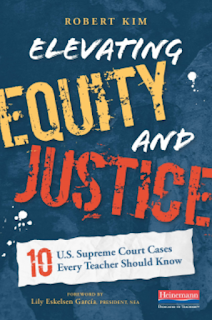
Review of Elevating Equity and Justice: 10 U.S. Supreme Court Cases Every Teacher Should Know by Robert Kim

This book review was written by Eugene Kernes

Book can be found in:
Genre = Law

Watch the Review

Elaborate Description

Overview:

Educators are extremely influential not just for academic outcomes, but also in life’s outcomes.  Educators set up many expectations for students as to what the student is capable of, and how to treat one another.  This book is about the cases that have changed how schools operate.  Elucidating what educators can and cannot do.  Informing who is to be taught and how.  Each case is a product of the changing time.  Each case is a product of parents wanting what is best for their children, and educators wanting what is best for their students.  Every case is presented with what happened to lead up to the problem, how the problem got resolved by the supreme court, who is impacted by the case, and practical stories of the impact that the case had on academic life.  Education is a very important factor in social life and the presented cases show how education has been modified to improve outcomes, but there are still many ways that education can be improved.  


Caveats?

This is a short book directed at busy teachers, who will be able to find more resources on how to handle certain situations at the end of each case.  Although the book’s efforts are for the betterment of school life, it has a slight political bias which can undermine understanding the issues from different perspectives. 


Questions to Consider while Reading the Book
•What is the raison d’etre of the book?  For what purpose did the author write the book?
•How did each case impact the function of teaching?
•How did each case impact the students?
•How can education be improved? 
•Who is to be taught?
•How should schools select their students?
•What do parents want from schools?
•What rights do students have? 

Book Details
My edition was provided by NetGalley
Edition ISBN:  9780325092140
Pages to read:   140
Publication:     2019
1st Edition:      2019
Format:           eBook

Ratings out of 5:
Readability    4
Content          4
Overall           4

Tuesday, November 10, 2020

Review of Law, Legislation and Liberty, Vol 1: Rules and Order by Friedrich A. Hayek

This review is written by Eugene Kernes

Book can be found in:
Genre = Law

Elaborate Description

The author is a very powerful thinker in pointing out trends in society that many claim are supposed to fix problems, but are actually the cause of the problem or creating many more problems. The main theme of the book is the dispersal of knowledge and how law is created. As there are many details of society that we cannot vocalize, there is a type of spontaneous order that arises that helps the society grow. Creating a 'law' used to be just finding out how to vocalize the proper actions that describe the spontaneous order. It is only relatively recently that humans began to create law which change the way people can behave. The only major drawback of the book is that it takes a few pages to get acquainted with what the author is trying to explain, and even then there are still difficulties in reading some parts of the book. This is a great book.


Book Details

Edition ISBN:  9780226320861
Pages to read:   145
Publication:     1983
1st Edition:      1972
Format:            Paperback

Ratings out of 5:
Readability    4
Content          5
Overall           5

Review of Law, Legislation and Liberty, Vol 2: The Mirage of Social Justice by Friedrich A. Hayek

This review is written by Eugene Kernes

Book can be found in:
Genre = Law

Elaborate Description

'The Mirage of Social Justice' is a great book which describes how the term 'Justice' is used inappropriately. Justice can only look at actions of particular individuals, not a spontaneous order of events which were not determined by direction of an individual. When those who are hurt by condition use the phrase 'unjust', they can manipulate the authority to provide for their ends by taking away resources from those who gained. When an authority uses the term 'social justice', they inevitably take away freedom from those who benefited from their conditions. As people have different values for different services, it is not unjust that some services obtain a higher income than others. This book is amazing at showing how the individual can benefit society out of self-interest and that a group actually undermines the value derived from society. The only problem with this book is that some parts of it are not easy to read. It would have helped to provide examples to allow digestion of the material.


Book Details

Edition ISBN:  9780226320830
Pages to read:   155
Publication:     1978
1st Edition:      1976
Format:            Paperback

Ratings out of 5:
Readability    4
Content          5
Overall           5

Review of Law, Legislation and Liberty, Vol 3: The Political Order of a Free People by Friedrich A. Hayek

This review is written by Eugene Kernes

Book can be found in:
Genre = Law

Elaborate Description

'The Political Order of a Free People' is the most economic based book out of all three volumes. Hayek mentions that in a free-market society competition exists for the discovery process of better products or ways of production, while a government oriented society cannot have a trial-and-error response to new information. Hayek sets out the groundwork for what government should do and when is it okay to use coercive power that government has a monopoly on. An underlying theme is that based on the democracy in its current form, is usually a reference to how the few take advantage of the many by manipulation with various instruments. Some passages are not so easy to read, but the book provides a lot of valuable insights.


Book Details

Edition ISBN:  9780226320908
Pages to read:   180
Publication:     1981
1st Edition:      1979
Format:            Paperback

Ratings out of 5:
Readability    4
Content          5
Overall           5

Review of The Law by Frédéric Bastiat

This review is written by Eugene Kernes

Book can be found in:
Genre = Law

Elaborate Description

Law is presented as a set of institutions, organized to prevent injustice. The problem with the law arises when the those who create the law provide legal justification for their mistreatment of people and their property. Those who create the laws can allow legal plundering of society. When the law allows for plunder, every individual or group would be more than tempted to plunder society via creation of laws to either prevent being plundered or to participate in the plunder without restraint on who they are. When the rights to plunder are obtained, those who profit from the plunder will do their best to prevent losing those rights.

Socialism is an institution that is looked at with a critical eye. Socialism is seen to make the laws perverse, having a top down approach. Those that preach for socialism are represented to have an intellectual superiority above other, and the job of the leader is to lead everyone else to liberty and peace. The issue raised against socialism reasons that socialist do not understand that their own fellow people have intelligence and a brain of their own, that their fellows would not appreciate being told to do something against their beliefs. Another problem posed with a socialist government is taking too much responsibility for things outside their control, which leads to taking credit for things they did not help create while having no accountability when things go awry. To take more responsibility would inevitable require force which goes against liberty.

The main point of the book is for government to prevent the plunder of people’s work. The theme raises many great points on the justification of the law. The book is short and fairly well written. The problem is that the author takes the law as singular situation, meaning no recognition that law is a bundle of rights lets everyone know what can and cannot be do. To prevent the plunder of an individual, might at times require another to lose their wealth due to the actions of the other.


Book Details

Edition ISBN:  9781614270577
Pages to read:   73
Publication:     2011
1st Edition:      1849
Format:            Paperback

Ratings out of 5:
Readability    5
Content          4
Overall           4

Review of Plunder: When the Rule of Law Is Illegal by Ugo Mattei, Laura Nader

This review is written by Eugene Kernes

Book can be found in:
Genre = Law

Elaborate Description

Wealth taken by coercion or manipulating information is plunder. It is supposed used to be illegal, but power nations have legalized the use of plunder. Powerful ideology helps legitimize plunder. During the Crusades, plundering the Arab cities was considered legitimate under their ideology. For the recent U.S., Neoliberalism has been the ideology that legitimizes plunder. The rule of law was meant to limit state intervention, but now it is a legitimizing factor.

Those who plunder can rationalize the legitimacy of their actions and consider themselves law-abiding even as it is contrary to history. This rationalization is enabled by false comparisons of what they have and what others do not. When providing support to does who do not have, the plunderer benefits via policies and the terms of support shortly after delivery, at the expense of the people after a few years. For example, financial institutions underwrite debt are rewarded with fees, but not punished when that debt is packaged in creative forms causing massive hardship on the people.

Legal intervention, or legal activism, help support plunder. Providing a top-down approach to many of the word problems exacerbates those problems, but the interventionists are not held accountable. International law is ambiguous creating selective justifications. Plundering nations which are not culturally aligned. Helping one countries problem while not helping other countries with the same problem or even at the expense of others. Made worse by the hypocritic policies which bind others to policies while the nations that dictates the terms would not accept the same policies such as protecting their own industries while imposing other country’s industries to compete in the open market.

Much of the book is an attack on Neoliberalism and favoring Keynesian. Their description of Neoliberalism is a huge caricature and contradictory. Their antagonist is Hayek with the Austrian school view of government as a corrupting force. The problem is that Hayek’s academic career can be as describing ‘plunder’. As the authors proclaim that Neoliberal policies are against a welfare state, they do not mention that Hayek was supportive of a basic income. Much of the claims they make such as Neoliberalism emphasizing individual choice are taken from a negative connotation while in the authors concluding chapter, they want an active citizenship emphasizing individual choice. While blaming Neoliberal policies, they seem not express that those policies are actually Keynesian. Under their description, Keynesian policies are usually supposed to provide, while Keynesian policies are actually countercyclical. In times of distress, the government should provide assistance while take the assistance away after distress. The authors blame Neoliberalism on the taking away of the assistance. The Keynesian policies the authors want as described in the conclusion can easily be considered plunder. The blame they place seems to be justification for their prescribed policies.

This book is well written but the example could have been better developed. Many issues are touched on briefly making their lesson not readily accessible. Even when going into depth for some examples, they are embedded with other examples. Transitions between the issues explained need work. The benefit of this book is proving a variety of ways with the legal institutions legalize plunder such as creating a market for justice. A market for justice is evident in the U.S. as the guilty can invest money to win the case while the innocent will not recuperate the legal expense.


Book Details

Edition ISBN:  9781405178952
Pages to read:   219
Publication:     2008
1st Edition:      2008
Format:            Paperback

Ratings out of 5:
Readability    4
Content          4
Overall           3

Review of First Thing We Do, Let's Deregulate All the Lawyers by Clifford Winston, Robert W. Crandall, Vikram Maheshri

This review is written by Eugene Kernes

Book can be found in:
Genre = Law

Elaborate Description

Many tasks can be done without the prerequisite of having a law degree from an ABA-accredited law school, passing a Bar examination, and being employed at a Bar lawyer firm. The problem is it is illegal for individuals to provide quality service for those tasks without having the three prerequisites. These three prerequisites are entry barriers which the authors would like to be reduced. The authors do think that individuals can obtain these credentials to signal their quality, but they are unnecessary in many cases where understanding law is required.

These entry barriers where put in place to prevent consumers from getting poor service. Rather then eliminate poor service, these barriers increased the income lawyers obtain as there is more demand for law while a very limited supply. The authors express that the increased salaries are not the result of doing higher quality work. Eliminating the entry barriers not only allows for consumers to judge the quality of legal services they obtain at the appropriate price that does not privilege wealth over justice, and forthcoming lawyers can practice law without just getting an academic experience.

This book has powerful ideas but they will resonate mostly with those who already see entry barriers as costly to social welfare. There is a huge reliance on statistics and explaining the statistics in granular detail, but a lack of explanation to many of the qualifiers. There is some history and building an understanding to the problem of entry barriers, but most reasoning is introduced without any forthcoming explaining to their importance. Those who are trained in economics will easily understand the issues.

Lawyers represent a very powerful interest group which can effectively lobby for policies which facilitate increased salaries but at a cost of society welfare. Entry barriers prevent high quality and appropriately priced services to compete with the interest group. Lawyers are important in society and some services would require a law degree, but the few small cases which require extensive training should not prevent the completion of the majority of tasks to be completed by those who do not have the degree.


Book Details

Edition ISBN:  9780815721901
Pages to read:   99
Publication:     2011
1st Edition:      2011
Format:            Paperback

Ratings out of 5:
Readability    3
Content          2
Overall           2